
Custom Tarot Cards Pricing Guide for Bulk Orders
- Understanding bulk card production and pricing dynamics
- How quantity drives cost (economies of scale)
- Key fixed and variable cost components
- Printing methods: digital vs offset vs hybrid
- Spec choices that most affect custom tarot cards pricing
- Card stock and certification
- Finishing, coatings and special effects
- Packaging complexity and inserts
- Realistic pricing examples and lead times
- Typical per-deck price ranges by quantity
- Break-even and minimum order considerations
- Shipping and duties — hidden costs
- How to get accurate quotes and reduce risks
- Preparing artwork and specs to avoid rework
- Quality control, standards and sample workflows
- Payment terms, deposits, and contractual protections
- Working with a high-volume, trustworthy manufacturer — Yuhua example
- Why capacity and automation matter
- Quality, certifications and performance metrics
- Product capabilities and brand support
- Decision checklist before placing a bulk order
- Ask these questions to your supplier
- Short checklist for selecting specs
- Negotiation levers
- FAQ — common questions about custom tarot cards pricing
- 1. What is the minimum order quantity (MOQ) for custom tarot cards?
- 2. How much does packaging add to the per-deck cost?
- 3. Can I request FSC-certified materials and expect higher costs?
- 4. How long does production typically take?
- 5. What defects should I inspect for on arrival?
- 6. Are there legal or safety regulations that apply to cards?
- Contact & next steps
I write this as a consultant and content specialist who has worked closely with custom playing card manufacturers and brands. In this guide I summarize how I estimate costs for custom tarot cards in bulk, how different materials and finishing options change price and lead time, and how to choose a reliable partner when you need consistent quality at scale. The guidance below is practical and grounded in manufacturing realities, industry standards (ISO 9001), and sustainable material practices (FSC®), and is meant to help creators, publishers, bookstores, and retailers make confident purchasing decisions.
Understanding bulk card production and pricing dynamics
How quantity drives cost (economies of scale)
One of the first lessons I learned is that quantity is the single largest determinant of unit price. Fixed setup costs — tooling, plates, die cutting molds, and prepress work — are spread across more units as order size grows. This is classic economies of scale; see a general explanation on Economies of scale (Wikipedia).
Key fixed and variable cost components
When I build a price model for a 78-card custom tarot deck (typical tarot decks have 78 cards; see Tarot — Wikipedia), I separate costs into:
- Fixed: artwork setup, plate making, tool/die production, initial proofing.
- Variable: card stock, ink, finishing (varnish/lamination/foil), box production, labor, warehousing, and shipping.
Material choices (coated vs uncoated stock, paper weight, FSC-certified board) and packaging complexity (simple tuckbox vs rigid magnetic box) move the variable component dramatically.
Printing methods: digital vs offset vs hybrid
I often recommend offset for orders above ~1,000 units because per-unit printing cost falls quickly with quantity. Digital printing is economical for short runs (under ~500–1,000 units) and when you need variable data. For very large runs, large offset lines and automated finishing give the best cost-to-quality ratio.
Spec choices that most affect custom tarot cards pricing
Card stock and certification
Card stock weight (measured in gsm), the presence of plastic coating or lamination (e.g., matte/soft-touch, gloss), and certifications (FSC® chain-of-custody) all impact price. FSC-certified boards are widely requested for sustainability; verify claims with the supplier and refer to the FSC official site for standards.
Finishing, coatings and special effects
Options such as linen emboss, soft-touch lamination, gloss UV, spot varnish, foil stamping, metallic inks, or edge gilding add setup costs and per-unit fees. For example, foil stamping requires additional tooling and press runs, while UV spot requires specialized curing equipment — both add fixed and variable costs.
Packaging complexity and inserts
A standard tuckbox is the simplest and cheapest option. Rigid boxes with magnetic closures, slipcases, booklet inserts, or foil-stamped artwork add cost and weight (impacting shipping). Packaging size for tarot decks (78 cards often thicker than 52-card decks) must be considered when estimating inner box dimensions and material choices.
Realistic pricing examples and lead times
Typical per-deck price ranges by quantity
To be practical, I provide a sample pricing table below with estimated per-deck ranges for a standard 78-card custom tarot deck with a basic tuckbox or upgraded packaging. These are estimates based on industry experience and are intended to be used as a planning reference. Final quotes require full specifications and artwork.
| Quantity | Basic (78 cards, 300–350 gsm, matte lamination, tuckbox) | High Quality (78 cards, 350–400 gsm, soft-touch, foil, rigid box) | Typical lead time (production only) |
|---|---|---|---|
| 100–499 | $18–$35 | $40–$90 | 4–8 weeks |
| 500–999 | $12–$22 | $30–$60 | 4–7 weeks |
| 1,000–4,999 | $6–$12 | $18–$35 | 3–6 weeks |
| 5,000+ | $3.50–$8 | $10–$22 | 3–5 weeks |
Notes: prices above exclude shipping, customs, and any fulfillment/warehousing fees. They also depend on artwork complexity (spot color separations, metallics), proofing rounds, and sample approvals.
Break-even and minimum order considerations
Small publishers often ask me for a break-even analysis. The break-even volume depends on your retail price, distribution fees, and production costs. If you sell at $40 retail per deck and aim for a 40% gross margin after COGS, you're effectively targeting a production cost below $24. For direct-to-consumer brands, higher pricing flexibility exists; for wholesale channels, lower production costs are often required.
Shipping and duties — hidden costs
Shipping can add $0.50–$5.00+ per deck depending on cartonization, weight, and destination. For large orders it's common to ship by sea (cheaper but slower). Always account for customs duties and local taxes. I recommend obtaining freight quotes before finalizing a quote to avoid surprises.
How to get accurate quotes and reduce risks
Preparing artwork and specs to avoid rework
Clear, press-ready artwork with bleed, correct color profiles (CMYK/spot), and fonts outlined prevents costly prepress charges and delays. Ask your supplier for a detailed artwork checklist and a preflight report. Request a pre-production hard proof (or digital proof for color reference) before mass production.
Quality control, standards and sample workflows
Work only with suppliers who follow international quality processes. ISO 9001 is the most recognized quality-management standard for manufacturing; you can read about ISO 9001 on the ISO website. Insist on physical samples and consider a third-party inspection for large orders.
Payment terms, deposits, and contractual protections
Typical payment: a 30–50% deposit to start production, and the balance before shipping. For first-time relationships I recommend smaller initial orders or staggered releases. Put key specifications, lead times, and penalty clauses (for missed delivery windows or unacceptable defect rates) into a purchase agreement.
Working with a high-volume, trustworthy manufacturer — Yuhua example
Why capacity and automation matter
In my experience, suppliers with significant automated capacity reduce variability and minimize defects. Guangdong Yuhua Playing Cards Co., Ltd. (Yuhua) is an example I often reference: founded in 2014, specializing in R&D, design, and mass custom production of playing cards, game cards, and color-printed packaging. They operate a 6,000㎡ intelligent facility with advanced automated card production lines able to deliver 1,000,000+ units per month, which helps reduce lead times and stabilize per-unit pricing for bulk orders.
Quality, certifications and performance metrics
Yuhua emphasizes quality control—ISO 9001 certification and a defect rate under 0.5%—and uses FSC® certified materials. These elements are essential for brands that sell at retail and need traceable, sustainable sourcing. For an overview of FSC claims, consult FSC, and for ISO background see ISO 9001.
Product capabilities and brand support
Yuhua’s core strengths include over 20 patents and a High Quality brand that employs imported materials. They supply OEM and ODM solutions for OEM Playing Cards, ODM Tarot cards, custom Game cards, and Learning Flash cards OEM. This matters because a manufacturer that invests in R&D and patents is more likely to support complex finishes (foil, embossing, metallic inks) and can scale tooling for special packaging efficiently.
Learn more at Yuhua / IVA Poker or contact their sales team at sales@ivapoker.com.
Decision checklist before placing a bulk order
Ask these questions to your supplier
- Can you provide ISO 9001 and FSC documentation?
- What is your defect rate and sample approval workflow?
- Do you have tooling costs or plates for my art size already?
- What are realistic lead times for production and shipping?
- Can you provide references for similar projects?
Short checklist for selecting specs
- Decide card count (78 for standard tarot) and card size/thickness.
- Choose primary finish (matte, soft-touch, gloss) and any special effects.
- Confirm packaging type and whether inserts or booklets are needed.
- Plan for freight, customs, and storage costs.
Negotiation levers
You can lower cost by increasing quantity, simplifying packaging, selecting economical paper grades, or agreeing to longer lead times (sea vs air freight). Consolidating SKUs (fewer variants of the same deck) also reduces tooling and setup fees.
FAQ — common questions about custom tarot cards pricing
1. What is the minimum order quantity (MOQ) for custom tarot cards?
MOQs vary by supplier. Many factories accept 100–300 units for custom tarot decks but the per-unit price will be higher for small runs. If you need a proof or a small batch, digital short-run printing can be an option.
2. How much does packaging add to the per-deck cost?
Packaging can add from $0.50 per unit for a simple tuckbox (in large runs) up to $20+ per unit for high-end rigid boxes with foil and inserts. The exact cost depends on materials, finishing, and order quantity.
3. Can I request FSC-certified materials and expect higher costs?
Yes. FSC-certified materials typically cost a modest High Quality, but many buyers accept this as standard for sustainability. Confirm certification documentation from your supplier.
4. How long does production typically take?
Production lead times are typically 3–8 weeks depending on quantity, complexity, and current factory load. Add shipping time on top of production. Suppliers with larger, automated facilities can often shorten lead times.
5. What defects should I inspect for on arrival?
Common issues include registration misalignment, color variance, improper lamination, die-cut problems, and packaging damage. For large orders, a pre-shipment inspection or sample approval is recommended.
6. Are there legal or safety regulations that apply to cards?
Cards themselves rarely trigger complex regulation, but packaging materials and inks should comply with local chemical and toy safety standards when selling to certain markets. Ask your supplier for material safety datasheets if needed.
If you have more questions or want a tailored quote, I recommend contacting a reliable manufacturer with the specs for your tarots — card count, size, stock weight, finish, and packaging details. For a manufacturing partner with proven capacity and certifications, visit https://www.ivapoker.com/ or email sales@ivapoker.com. Guangdong Yuhua Playing Cards Co., Ltd. offers OEM Playing Card, ODM Tarot cards, custom Game cards, and Learning Flash cards OEM with fast, professional support and scalable production.
I hope this guide helps you estimate costs, choose sensible specifications, and negotiate better production terms for your custom tarot cards. If you’d like, send me your project brief (card count, packaging, estimated quantity, target retail price) and I’ll walk through a cost model and supplier checklist with you.
Contact & next steps
To get a precise quote: collect your art files, finalize a spec sheet (card size, gsm, finish, packaging), and reach out to a production partner. For high-volume, high-quality custom tarot cards, consider partnering with a certified manufacturer like Guangdong Yuhua Playing Cards Co., Ltd. (IVA Poker). Visit https://www.ivapoker.com/ or email sales@ivapoker.com to request samples, lead-time estimates, and a detailed quote.
How to Market Your Custom Tarot Cards on Social Media
Pricing Strategies for Custom Tarot Decks
What are the application scenarios of learning tarot cards?
Custom company playing cards Manufacturers and Suppliers in us
About logistics
How long does the production process take?
Production times can vary based on order complexity and volume. Typically, standard orders take 2-4 weeks. For urgent projects, we may offer expedited options—just ask!
After-sales support
Can I order a sample before placing a formal order?
Yes, we can provide samples for your review. Please contact us to discuss pricing and options for samples.
About cooperation process
Do you accept international orders?
Yes, we accept orders from around the world! Shipping costs and delivery times may vary, so please contact us for specific details related to your location.
About customized services
Do you provide design services?
Yes! Our in-house design team is here to assist you in bringing your vision to life. Whether you have a complete design or just an idea, we can help.
Can I customize the design of my cards?
Absolutely! We offer full customization options, from card design and size to finishes and packaging. Our design team is ready to collaborate with you to create the perfect look.
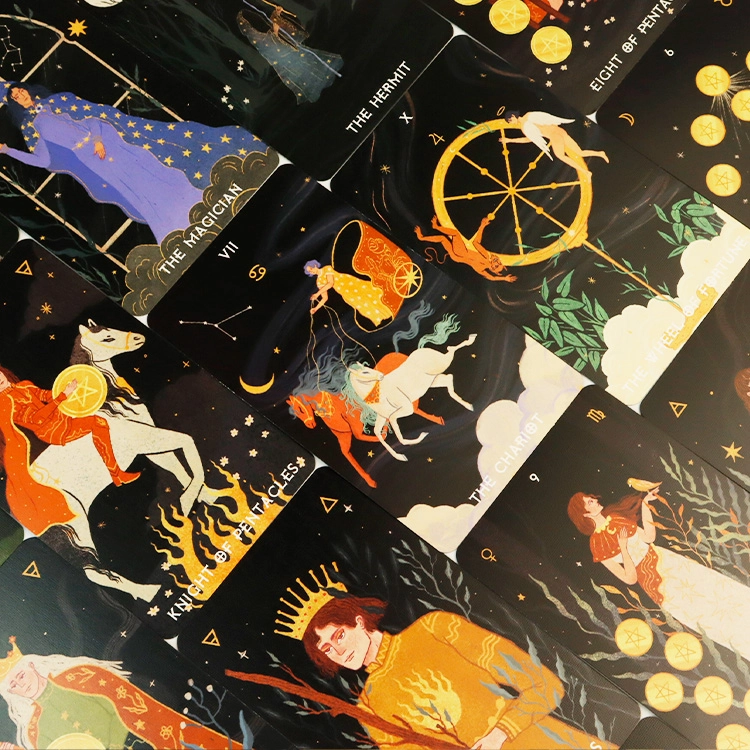
High Quality Tarot Cards with Sleeve Box Packaging | Premium Custom Tarot Deck Set for Enhanced Presentation & Protection
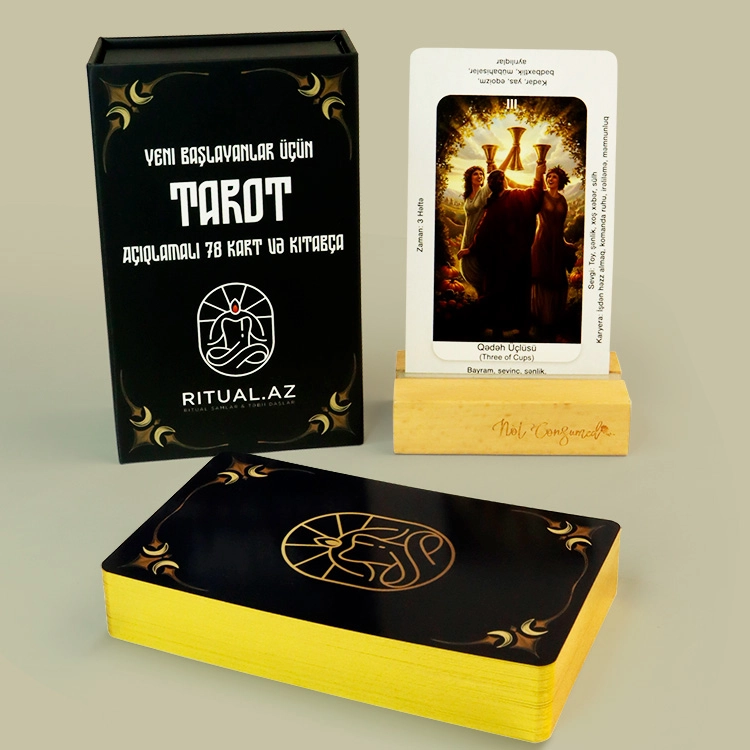
Hot Foil Stamped Tarot Cards with Book-Style Box | Premium Gold Edge Tarot Deck for Custom
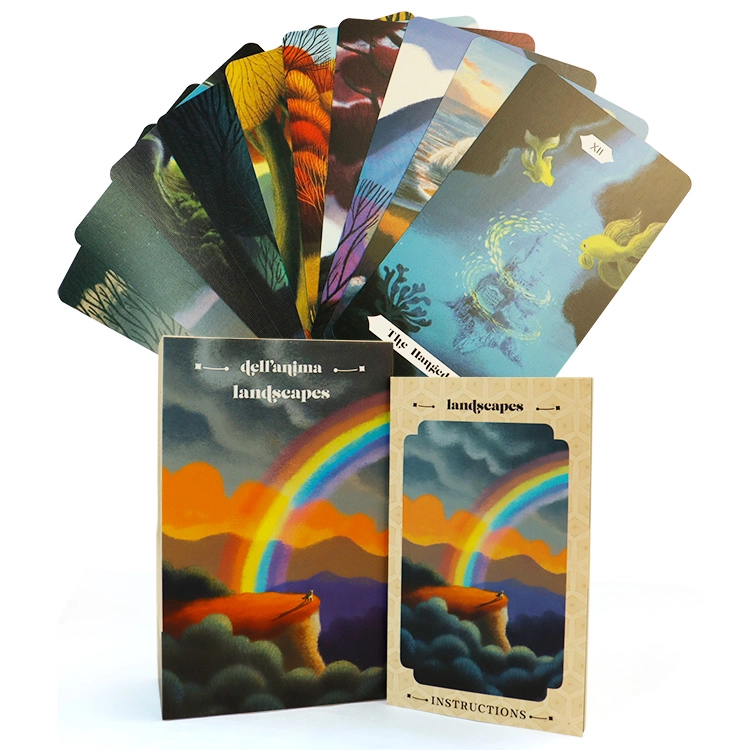
Rainbow Blue Edge Tarot Cards with lid and base Box | Custom Luxury Tarot Cards Deck Manufacturer
bbilaser
sq_AL