Quality Control Checklist for Professional Playing Card Manufacturers
- Why quality control matters for card makers
- Brand reputation and user experience
- Regulatory and procurement requirements
- Key semantic concepts
- Incoming materials and supplier controls
- Paper and cardstock verification
- Ink, varnish and coating validation
- Packaging and accessory materials
- Production-process controls
- Pre-production verification
- Print press controls and color management
- Cutting, coating, and finishing
- Inspection criteria, testing, and defect classification
- Sampling plans and AQL thresholds
- Objective tests: measurements and instruments
- Defect matrix and action levels
- Post-production, packaging, and logistics
- Final inspection and certification
- Packaging tests and transport simulation
- Traceability and lot control
- Integrating automation and continuous improvement
- Automated inspection and data collection
- KPIs and continuous improvement
- Training and operator competency
- Case: Guangdong Yuhua Playing Cards Co., Ltd. — QC in practice
- Resources, standards, and references
- Frequently Asked Questions (FAQ)
- 1. What are the most common defects in professional playing card production?
- 2. How should I choose card substrate for different products?
- 3. What sampling plan is recommended for a 50,000-deck production run?
- 4. How do you measure color accuracy for brand-critical prints?
- 5. What certifications should a professional playing card manufacturer have?
- 6. How can automation reduce defect rates?
- Contact, consultation, and next steps
Quality control is the backbone of any professional playing card operation. This guide summarizes a practical, measurable Quality Control Checklist for Professional Playing Card Manufacturers that covers incoming materials, production-process controls, color and tactile consistency, post-production inspection, and packaging and logistics. It integrates industry best practices, verifiable testing methods, and supplier/production metrics to help factories, OEM partners, and brands deliver consistent, low-defect playing cards for casinos, game publishers, education, and promotional markets.
Why quality control matters for card makers
Brand reputation and user experience
Professional playing card quality directly affects shuffle feel, card handling, readability, and long-term durability. Consistent color, uniform thickness, and precise cut lines are essential for casino playing cards, collectible decks, and tabletop games. Poor QC leads to customer complaints, returns, and reputational damage—especially for high-value products like custom game cards and tarot decks.
Regulatory and procurement requirements
Many buyers require certifications such as FSC® for sustainable paper and ISO 9001 for quality management. Compliance reduces procurement friction and supports global sales. For background on playing card history and manufacturing context, see the Playing card (Wikipedia) entry.
Key semantic concepts
Throughout this checklist we reference terms important to a professional playing card manufacturer: custom playing cards, card substrates, linen finish, color consistency, die-cutting tolerances, coating/finish adhesion, print registration, and automated inspection. Embedding these terms helps cross-functional teams (R&D, production, QA, and sales) align on measurable targets.
Incoming materials and supplier controls
Paper and cardstock verification
Checklist items: verify FSC® certification, grammage (gsm) tolerance, moisture content, and core composition (plastic-coated, clay-coated, or true casino stock). Measure thickness with a micrometer at multiple points and compare to spec (example tolerance ±0.05 mm). Source reference: Forest Stewardship Council (FSC®).
Ink, varnish and coating validation
Keep batch certificates for colorant and varnish suppliers. Run lab tests for colorfastness (ISO 105 series) and adhesion (cross-cut test per ASTM D3359). Maintain spectral targets (CIELAB L*a*b) for primary inks and validate on press with a spectrophotometer (ΔE ≤ 2 for critical brand colors).
Packaging and accessory materials
Inspect tuck boxes, belly bands, shrink-wrap, and adhesives. Check that packaging materials meet crush strength, print quality, and barrier requirements for intended logistics routes. For promotional cards, verify custom foil or embossing dies before mass run.
Production-process controls
Pre-production verification
Run a pilot/sample deck and keep signed approval (golden sample). Confirm art files, bleed, trim, and safety areas. Use imposition proofing and soft-proofing along with a press proof. Record all approval timestamps in the production tracking system.
Print press controls and color management
Implement in-line color checkpoints every N sheets depending on run length (e.g., every 5,000 sheets). Use process control strips and measure with spectrophotometry; maintain a print log with ΔE results. For offset or digital printing, map color variance trends and stop-run if cumulative deviation exceeds tolerance.
Cutting, coating, and finishing
Monitor die-cut accuracy, corner radius consistency, and lamination adhesion. Critical tolerances include edge-to-edge registration within ±0.3 mm and corner radius variation within ±0.2 mm. For linen or embossed finishes, test tactile uniformity with coefficient-of-friction measurements where relevant.
Inspection criteria, testing, and defect classification
Sampling plans and AQL thresholds
Adopt statistically-based sampling such as ISO 2859-1 (AQL) for lot acceptance. Define critical, major, and minor defects. Example acceptance criteria for professional playing card runs: critical defects 0 per lot, major defects AQL 0.65, minor defects AQL 4.0. Tailor sampling size to production volume and customer criticality (casino grade vs promotional decks).
Objective tests: measurements and instruments
Use calibrated instruments: micrometers for thickness, spectrophotometers for color, tensile testers for lamination, and peel testers for adhesive strength. Log calibration dates and traceability to standards. For reference on quality management standards, see ISO 9001 (ISO).
Defect matrix and action levels
Create a defect matrix that lists defect types, sample photos, severity, and required actions (repair, rework, or scrap). Examples: miscut (major), color deviation >ΔE2 (major), surface scratches (minor). Require root-cause analysis and corrective action plans for recurrent issues.
| Checkpoint | Target/Tolerance | Action if out-of-tolerance |
|---|---|---|
| Card thickness | Specified ±0.05 mm | Stop line, remeasure batch, quarantine |
| Color (ΔE) | ΔE ≤ 2 (brand critical ≤1.5) | Reprofile press, reprint if necessary |
| Die-cut registration | ±0.3 mm | Adjust tooling, inspect 100% next 1000 units |
| Surface defects | Zero critical (spots/contaminants) | Clean press, review materials, rework/scrap |
Post-production, packaging, and logistics
Final inspection and certification
Before packaging, perform final inspections on master cartons and random decks. Check for pack count accuracy, shrink-wrap integrity, and barcode/label correctness. Issue certificates of conformity for FSC and any requested tests.
Packaging tests and transport simulation
Conduct transit simulation tests: drop, vibration, and stack compression per applicable standards. Validate packaging protects against humidity and crushing during sea freight. For international shipping, ensure compliance with import labeling requirements and material declarations.
Traceability and lot control
Implement lot coding on outer cartons and track production parameters (press ID, operator, shift, material lot numbers). Maintain digital records for at least the warranty period or as required by specific customers (casinos often require longer traceability windows).
Integrating automation and continuous improvement
Automated inspection and data collection
Modern production lines benefit from machine-vision inspection for print defects, slitting, and registration checks. Integrate automated counters and defect logging into an MES (Manufacturing Execution System) to analyze trends in real time and reduce human error.
KPIs and continuous improvement
Define KPIs such as defect rate (%) per million units, on-time delivery, customer returns per 10k units, and scrap rate. Aim for continuous reduction—industry-leading plants often target defect rates below 0.5% for finished decks. Use Six Sigma or PDCA cycles to implement improvements.
Training and operator competency
Regularly train press operators and QA staff on new materials, tooling changes, and inspection criteria. Maintain competency checklists and assess operators with practical exams for critical tasks (color matching, die alignment).
Case: Guangdong Yuhua Playing Cards Co., Ltd. — QC in practice
Guangdong Yuhua Playing Cards Co., Ltd., founded in 2014, specializes in the R&D, design, and mass custom production of playing cards, game cards, and color-printed packaging. With a 6,000㎡ intelligent facility, we offer advanced, automated card production lines capable of 1,000,000+ units per month. Our core strengths include FSC® certified materials, ISO 9001 quality control, a defect rate under 0.5%, and over 20 patents. Our High Quality brand uses imported materials and is trusted worldwide. We serve global markets with custom card solutions for casinos, games, education, and more—delivering fast, high-quality results with professional support.
Yuhua integrates multi-point QC checks described in this guide: incoming material verification, in-line spectrophotometric color control, automated vision inspection, and final certification. We maintain a digital traceability system linking each carton to press IDs, operator logs, and QC reports. This structure enables rapid root-cause analysis and corrective actions, keeping defect rates consistently low.
We are committed to providing customers with high-quality and efficient playing card production services. Yuhua advantages include advanced automation, certified sustainable materials (FSC®), ISO 9001-driven processes, rapid scale (1,000,000+ units/month), and a defect rate under 0.5%. Our main OEM/ODM products: OEM Playing Card, ODM Tarot cards, custom Game cards, and Learning Flash cards OEM.
Resources, standards, and references
- Playing card manufacturing overview: Wikipedia - Playing card
- Quality management: ISO 9001 (ISO)
- Sustainable sourcing: Forest Stewardship Council (FSC®)
Frequently Asked Questions (FAQ)
1. What are the most common defects in professional playing card production?
Common defects include miscuts, color deviation, lamination bubbles or peeling, surface scratches, and incorrect pack counts. Defect frequency depends on material control and press setup; using the checklist above reduces these significantly.
2. How should I choose card substrate for different products?
Choose based on use-case: casino playing cards typically use higher-weight, plastic-coated or composite casino stock for durability; retail or collectible decks may use clay-coated or specialty art papers; educational flash cards often require thicker, matte-coated board. Verify gsm, stiffness (Mullen or ICM), and moisture content to match performance needs.
3. What sampling plan is recommended for a 50,000-deck production run?
Use ISO 2859-1 (AQL) to determine sample size. For a 50,000-deck lot with moderate risk, a common approach is to inspect a sample of several hundred units (e.g., sample size code letter 'L' or 'M' depending on chosen AQL). Set lower AQLs for major defects on casino or High Quality orders.
4. How do you measure color accuracy for brand-critical prints?
Use a calibrated spectrophotometer and measure in CIELAB values. Define ΔE tolerance (commonly ≤2; brand-critical ≤1.5). Maintain a color management workflow with ICC profiles and perform in-line checks at regular intervals during press runs.
5. What certifications should a professional playing card manufacturer have?
Key certifications: ISO 9001 for quality management, FSC® for sustainable paper sourcing, and any customer-specific audits (casino compliance, safety standards for children’s products). These demonstrate system-level controls and increase buyer trust.
6. How can automation reduce defect rates?
Automation such as machine-vision inspection, automated counting, and in-line spectrophotometry removes human variability, increases inspection coverage (100% checks for some defects), and provides traceable data for root-cause analysis—helping reach defect rates below industry averages.
Contact, consultation, and next steps
If you are evaluating suppliers or need an operational QC checklist tailored to your product (casino decks, tarot, custom game cards, or learning flash cards), Guangdong Yuhua Playing Cards Co., Ltd. provides OEM and ODM services with full QC documentation, pilot runs, and rapid scaling. Contact us for a QC audit, sample production, or to request a capability and QC dossier. Visit our product pages or reach out for consultation and a quotation.
For custom quotes, QC audits, or to view our sample library, contact Guangdong Yuhua Playing Cards Co., Ltd. today and discover how our automated production, FSC® materials, and ISO 9001 processes deliver reliable, low-defect professional playing card solutions.
Custom Tarot Cards: How to Order Samples and Proofs
Unlocking Your Creativity: How to Create Custom Playing Cards from Concept to Completion
Custom custom made poker playing cards Manufacturers and Suppliers in UK
How to Design Custom Playing Cards: Tips for Beginners
About customized services
Do you offer samples?
Yes! We can provide samples of our card materials and finishes. Please contact us to request samples relevant to your project.
Can I customize the design of my cards?
Absolutely! We offer full customization options, from card design and size to finishes and packaging. Our design team is ready to collaborate with you to create the perfect look.
About logistics
Can you handle shipping and fulfillment?
Yes! We offer comprehensive fulfillment services, including storage, packing, and shipping. You can rely on us to ensure your cards reach their destination safely and on time.
About product selection
What materials do you use for your cards?
We use high-quality, durable materials to ensure the best finish and longevity for your cards. Options include standard cardstock, premium finishes, and eco-friendly materials.
About cooperation process
Do you accept international orders?
Yes, we accept orders from around the world! Shipping costs and delivery times may vary, so please contact us for specific details related to your location.
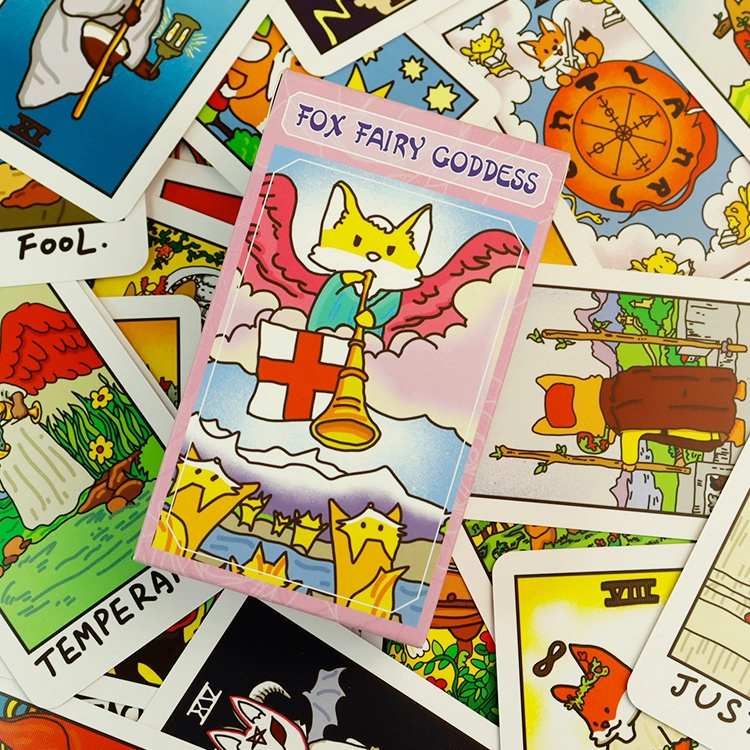
Custom Printing Tarot Cards with fox fairy Goddess on Premium Box for Complete Tarot Cards Deck and Guidebook

High Quality Eco-Friendly Durable Personalized Design Wildflowers Playing Cards with Custom Design Logo and Box

OEM Custom Driving Theory Cards | Personalized Traffic Rules & Test Prep Flashcards in Multiple Languages for Wholesale