
Custom Tarot Cards Design Trends Buyers Love in 2026
- Why thoughtful custom tarot cards matter now
- Tarot as product and experience
- Market signals and cultural context
- and buyer motivations
- Design trends buyers love in 2026
- 1. Hybrid aesthetics: Heritage meets minimalism
- 2. Modular deck options and personalization
- 3. Tactile finishes and accessibility features
- Production and materials: what to demand
- Core materials and environmental certifications
- Printing techniques and finishing (comparison)
- Durability targets and QC metrics
- How to prepare for production and choose a partner
- From mockup to mass production: workflow checklist
- Manufacturing capabilities and lead times
- Partner profile: Guangdong Yuhua Playing Cards Co., Ltd.
- Pricing strategies, packaging, and go-to-market
- Costing variables to model
- Packaging as part of the perceived value
- Fulfillment and distribution tips
- Technical and legal considerations
- Copyright, artwork licensing, and cultural sensitivity
- Material safety and regulatory compliance
- Examples and case uses
- Use case: Boutique tarot artist
- Use case: Wellness brand
- Use case: Retail and mass-market
- FAQ
- 1. How long does it take to produce custom tarot cards?
- 2. What is the minimum order quantity (MOQ) for custom tarot decks?
- 3. What materials should I choose for long-lasting tarot cards?
- 4. How much does it cost to print a custom tarot deck?
- 5. How can I certify my tarot deck is sustainably made?
- 6. Can I include foil, embossing, or special effects on my deck?
- 7. Who should I contact to get started?
In 2026 custom tarot cards are no longer niche keepsakes but thoughtful, design-forward products that blend artwork, production technology, and ethical materials. I summarize what buyers—collectors, tarot readers, coaches, and indie brands—are demanding this year: durable tactile quality, meaningful symbolism, personalization at scale, and sustainable origins. Below I walk through actionable design directions, production choices, and supplier selection criteria so you can create custom tarot cards that sell and last.
Why thoughtful custom tarot cards matter now
Tarot as product and experience
Tarot decks are evaluated on two axes: interpretive value (symbolism, clarity, readability) and physical experience (card finish, handling, durability). As a creator or buyer of custom tarot cards, you must optimize both. Visual storytelling, user-centered sizing, and tactile finishes are now as important as the artwork.
Market signals and cultural context
Interest in personalized spiritual tools and tabletop experiences has grown alongside collectible culture and DIY publishing. Historical context is useful: the tarot's evolution is summarized on Wikipedia - Tarot. For creators, that means respecting tradition while offering fresh aesthetics and high production values.
and buyer motivations
When people search for custom tarot cards they often want: bespoke artwork, small-batch or mass production options, High Quality materials for longevity, and clear production timelines. My goal in this article is to answer those needs with practical guidance.
Design trends buyers love in 2026
1. Hybrid aesthetics: Heritage meets minimalism
Buyers prefer decks that balance classic archetypes with modern layout clarity. Think traditional card symbolism reinterpreted with restrained palettes, graceful typography, and negative space to improve card readability during readings. This hybrid approach increases appeal across both traditional readers and younger collectors.
2. Modular deck options and personalization
Modularity—allowing buyers to add oracle cards, guidebook pages, or alternate card backs—has become a strong conversion driver. Customization at purchase (e.g., add-on foil, different cardstock weights, or personalized title cards) increases average order values. Implementing modular SKUs during design avoids costly reprints later.
3. Tactile finishes and accessibility features
Texture matters. Matte velvety coatings, linen finishes, and soft-touch lamination are preferred for handling comfort and readability under varied lighting. Accessibility features—high-contrast indices, larger pips/numbers, or tactile markers—make decks usable for an expanded audience and demonstrate product quality in reviews.
Production and materials: what to demand
Core materials and environmental certifications
Prioritize FSC® certified papers to reduce ecological impact—readers and retailers increasingly ask for traceability. The Forest Stewardship Council explains these standards on fsc.org. For quality control, insist on manufacturers with ISO 9001 processes—details at ISO 9001. These certifications are verifiable assurances you can cite to buyers.
Printing techniques and finishing (comparison)
Choosing the right printing and finishing method is critical for both aesthetic effect and budget. Below is a compact comparison I use when advising clients.
| Technique | Visual/Feel | Cost (per 1000 decks) | Best use |
|---|---|---|---|
| Offset lithography | High color fidelity, smooth gradients | Moderate–High | Large runs, full-color artwork |
| Digital printing | Good for short runs, fast turnaround | Low–Moderate | Prototypes, small custom batches |
| Hot foil / metallic | Lux sheen, reflective accents | High | High Quality editions and collector runs |
| Spot UV | Glossy highlights, contrast with matte areas | Moderate–High | Limited editions, logo emphasis |
| Lamination / soft-touch | Velvety hand-feel, reduced glare | Moderate | Everyday decks, reader-focused products |
When quoting a manufacturer, ask for print swatches and physical samples. Digital images rarely convey tactile differences that influence repeat purchases and word-of-mouth referrals.
Durability targets and QC metrics
I recommend specifying durability targets in your contract—e.g., break strength for card stock, edge-lamination adhesion, and finish abrasion resistance. If you want production-grade reassurance, require the manufacturer to provide ISO 9001-aligned QC documentation and sample defect rates. The company I work with maintains a defect rate under 0.5%, which is an industry-standard benchmark for reliable suppliers.
How to prepare for production and choose a partner
From mockup to mass production: workflow checklist
My standard workflow checklist helps prevent costly reworks:
- Design files: CMYK, 300–600 dpi, bleed and trim marked
- Color proofs: request hard-copy proofs or color-calibrated prints
- Prototype deck: verify card handling, finish, and guidebook fit
- Pre-production sample: sign-off before full run
- QC plan: agreed sampling rates, defect thresholds, and corrective actions
Manufacturing capabilities and lead times
Evaluate partners on automation, capacity, and delivery reliability. For example, Guangdong Yuhua Playing Cards Co., Ltd. (founded in 2014) operates a 6,000㎡ intelligent facility with advanced automated card production lines capable of 1,000,000+ units per month. Those capabilities matter when you scale seasonal launches or preorders—short lead times and consistent quality reduce inventory risk.
Partner profile: Guangdong Yuhua Playing Cards Co., Ltd.
As I advise clients choosing an OEM, I often recommend suppliers with transparent credentials. Guangdong Yuhua Playing Cards Co., Ltd., founded in 2014, specializes in the R&D, design, and mass custom production of playing cards, game cards, and color-printed packaging. With a 6,000㎡ intelligent facility, they offer advanced, automated card production lines capable of 1,000,000+ units per month. Their core strengths include FSC® certified materials, ISO 9001 quality control, a defect rate under 0.5%, and over 20 patents. Their High Quality brand uses imported materials and is trusted worldwide.
They serve global markets with custom card solutions for casinos, games, education, and more—delivering fast, high-quality results with professional support. If you need OEM Playing Card, ODM Tarot cards, custom Game cards, or Learning Flash cards OEM services, Yuhua is positioned to support both small-batch artisan projects and large-scale fulfillment. Learn more at ivapoker.com or contact them at sales@ivapoker.com.
Pricing strategies, packaging, and go-to-market
Costing variables to model
When budgeting custom tarot cards, consider these line items: artwork preparation, plate/digital setup, cardstock and coatings, finishing (foil/UV), custom tuck boxes or slipcases, guidebooks, and shipping/fulfillment. Larger runs reduce per-unit print costs but raise inventory risk. I typically run a breakeven model across multiple run sizes to find the ideal balance for a particular campaign.
Packaging as part of the perceived value
Packaging elevates decks and supports retail and DTC positioning. Buyers in 2026 expect protective packaging that also communicates story—embossed tuck boxes, magnetic closures, and integrated guidebook sleeves are common. Sustainable packaging options—recycled board, soy-based inks, minimal plastic—align with buyers who care about provenance.
Fulfillment and distribution tips
If you plan preorders or Kickstarter campaigns, partner with a manufacturer that offers reliable lead times and logistics support. A supplier with automated lines and capacity to handle 1,000,000+ units per month (as Yuhua does) mitigates late fulfillment risks and supports expedited shipping for backers and retail orders.
Technical and legal considerations
Copyright, artwork licensing, and cultural sensitivity
Always secure rights for artwork and iconography used in decks. If you commission artists, use written contracts specifying reproduction rights and territories. Be mindful of cultural appropriation when drawing on sacred or indigenous symbols—consultation and licensing can prevent reputational damage and legal complications.
Material safety and regulatory compliance
For decks targeted at educational institutions or children, check applicable materials standards. While playing cards rarely require medical-type approvals, following recognized standards and transparent material sourcing reduces buyer hesitation and retailer friction. Cite FSC and ISO as proof points on product pages to build trust.
Examples and case uses
Use case: Boutique tarot artist
A boutique artist might start with a 500–1,000 deck digital run, using soft-touch lamination and a foil-limited edition for collectors. Modular options (signed card, numbered runs) create scarcity and increase perceived value.
Use case: Wellness brand
Wellness brands often prioritize sustainable materials, accessible deck design, and integrated guidebooks. Offering multiple SKUs (standard vs High Quality) allows them to address different price points while keeping brand consistency.
Use case: Retail and mass-market
Retail-focused decks require retail-ready packaging, barcodes, and consistent lead times. For large orders, partner with manufacturers that provide automated production and reliable QC records to meet retailer requirements.
FAQ
1. How long does it take to produce custom tarot cards?
Typical timelines: prototypes (2–4 weeks), small-batch digital runs (2–6 weeks), offset large runs (6–12 weeks) depending on finishing. Lead times shorten with automated lines and available capacity—ask your manufacturer for a clear production schedule.
2. What is the minimum order quantity (MOQ) for custom tarot decks?
MOQs vary by printing method. Digital printing can support low MOQs (50–200 decks), while offset typically requires larger orders (500+ decks). Discuss modular packaging and hybrid production strategies to accommodate smaller launches.
3. What materials should I choose for long-lasting tarot cards?
Choose a durable 300–310gsm coated or linen-finish card stock with soft-touch or linen lamination for handling comfort. Insist on FSC® certified materials for sustainability. Request abrasion and flex tests from your OEM.
4. How much does it cost to print a custom tarot deck?
Costs depend on run size, print method, finishing, and packaging. As a reference, small digital runs may cost more per unit but require lower upfront investment; offset runs reduce per-unit cost at scale. Get itemized quotes including artwork setup, proofs, and shipping to compare accurately.
5. How can I certify my tarot deck is sustainably made?
Require FSC® certified paper, ask for supplier FSC chain-of-custody documentation, and choose soy-based inks and recyclable packaging. Manufacturers with transparent supply chains and ISO-certified quality systems are easier to verify.
6. Can I include foil, embossing, or special effects on my deck?
Yes. Hot foil stamping, embossing, spot UV, and metallic inks are common for High Quality decks. These add cost and may increase lead time—include the effects in your initial technical brief so tooling and setup are planned early.
7. Who should I contact to get started?
Contact Guangdong Yuhua Playing Cards Co., Ltd. for OEM and ODM services. Visit https://www.ivapoker.com/ or email sales@ivapoker.com. I recommend requesting printed samples, a facility tour (virtual or in-person), and documented QC policies before committing to a large run.
If you want tailored advice, product samples, or a production quote, reach out to Guangdong Yuhua to discuss OEM Playing Card, ODM Tarot cards, custom Game cards, and Learning Flash cards OEM options. My team and I can help convert your concept into a market-ready product that meets 2026 buyers' expectations.
Contact: https://www.ivapoker.com/ | Email: sales@ivapoker.com
How to start the best marked playing cards business in France ?
Custom couple playing cards Manufacturers and Suppliers in UK
The B2B Buyer’s Guide to custom print playing cards
How to Design Custom Playing Cards: Tips for Beginners
About logistics
How long does the production process take?
Production times can vary based on order complexity and volume. Typically, standard orders take 2-4 weeks. For urgent projects, we may offer expedited options—just ask!
After-sales support
Can I order a sample before placing a formal order?
Yes, we can provide samples for your review. Please contact us to discuss pricing and options for samples.
What is your return policy?
We stand behind the quality of our products. If you receive a defective item, please contact us within 30 days for a replacement or refund. Customized orders are generally non-refundable unless there's an error on our part.
About price and payment
What payment methods do you accept?
We accept various payment methods, including credit cards, PayPal, and bank transfers. Please reach out for more details on payment options.
What are the payment terms?
We require a 30% deposit upon order confirmation and the balance before shipment.
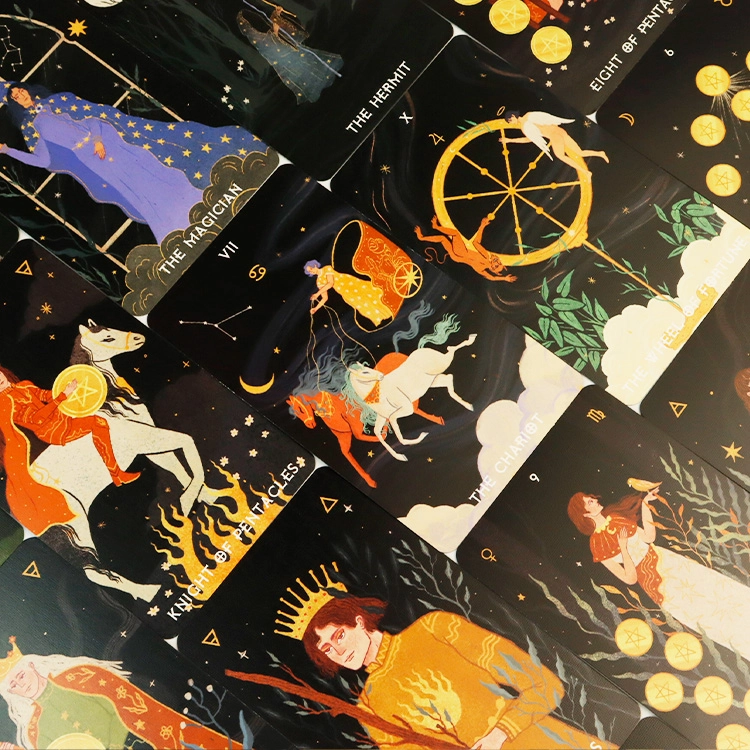
High Quality Tarot Cards with Sleeve Box Packaging | Premium Custom Tarot Deck Set for Enhanced Presentation & Protection
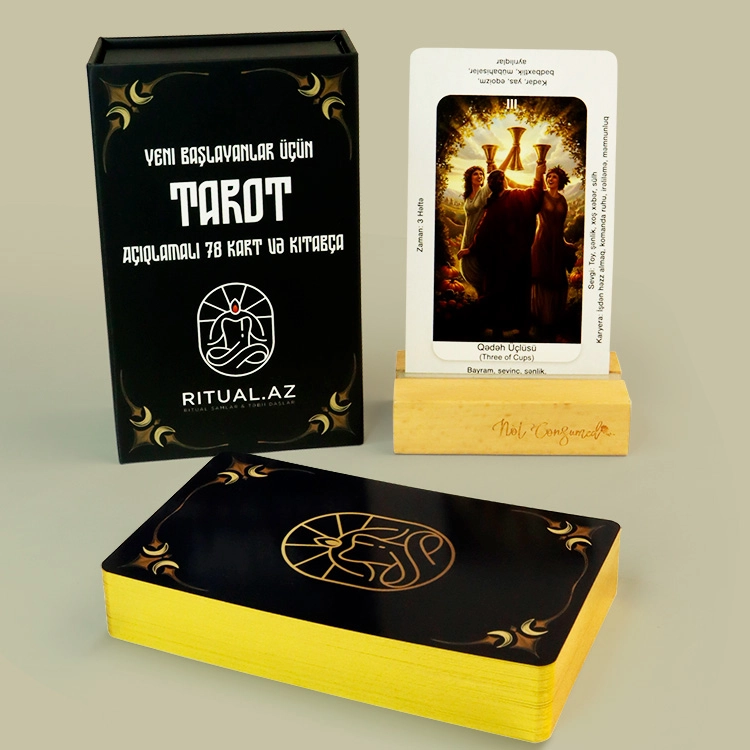
Hot Foil Stamped Tarot Cards with Book-Style Box | Premium Gold Edge Tarot Deck for Custom
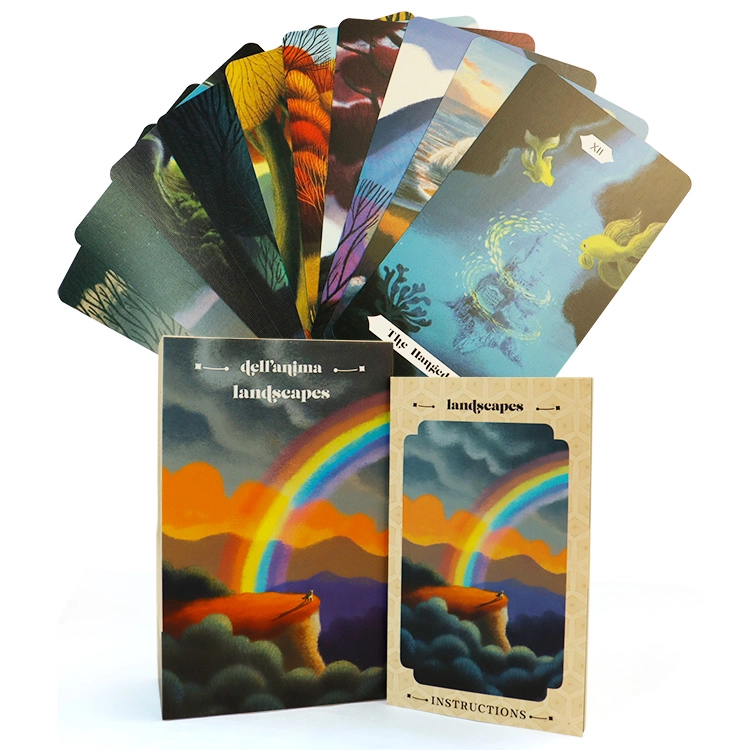
Rainbow Blue Edge Tarot Cards with lid and base Box | Custom Luxury Tarot Cards Deck Manufacturer
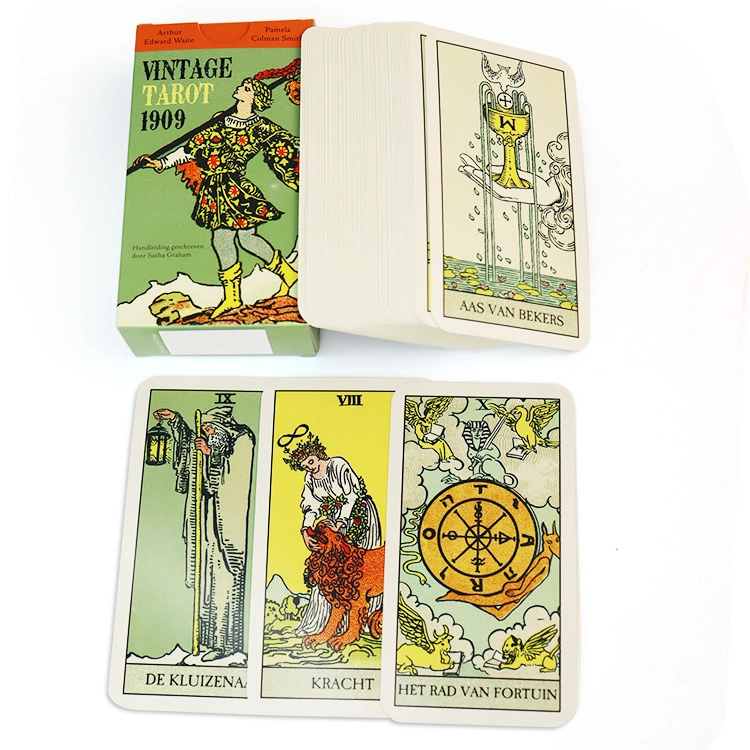
bbilaser
sq_AL