
Top Custom Tarot Card Design Trends for 2026
- Designing the Future of Divination
- Why custom tarot cards are a strategic product for creators and brands
- Trend 1 — Sustainable & certified materials for custom tarot cards
- Trend 2 — Augmented Reality and NFC-enabled custom tarot cards
- Trend 3 — Minimalist aesthetics, modular decks and modular tarot card systems
- Trend 4 — Diversified iconography & inclusive representation in custom tarot cards
- Trend 5 — Limited editions, collaborations & luxury packaging for custom tarot cards
- Production & quality standards: what to expect when ordering custom tarot cards
- Choosing the right manufacturer for custom tarot cards
- How Guangdong Yuhua supports high-quality custom tarot cards and OEM/ODM services
- Practical checklist before placing an order for custom tarot cards
- Cost vs. value — making budget decisions for custom tarot cards
- FAQs — Custom tarot cards (questions buyers search for)
- Contact and next steps
- References
Designing the Future of Divination
The tarot market has evolved from boutique print runs to a hybrid ecosystem where designers, publishers, spiritual practitioners, and brands demand both aesthetic innovation and industrial reliability. For anyone ordering or producing custom tarot cards in 2026 — artists, small presses, spiritual entrepreneurs, or corporate brands — understanding design trends and production realities is essential to deliver decks that resonate, ship on time, and meet quality and sustainability expectations.
Why custom tarot cards are a strategic product for creators and brands
Custom tarot cards are more than printed imagery: they are physical experiences that combine art, narrative, tactile quality, and ritual use. From subscription-box offerings to museum retail, and from experiential marketing to educational tools, the demand for fully custom tarot cards continues to grow because they: (1) strengthen brand storytelling, (2) create collectible scarcity, (3) enable niche representation, and (4) command higher price points when production quality is excellent. If you plan to commission or sell custom tarot cards, aligning design choices with production capabilities and market expectations will determine your deck’s success.
Trend 1 — Sustainable & certified materials for custom tarot cards
Sustainability is now a baseline expectation for many buyers of printed products. In 2026, decks that emphasize recycled stocks, responsibly sourced fibers, and low-impact inks outperform generic offerings in reputation and retail acceptance. Key production decisions to consider:
- FSC®-certified card stock: Demonstrates responsible forest management and is often required by eco-conscious retailers and institutions.
- Vegetable-based or low-VOC inks: Reduce environmental impact and deliver vivid colors that age better than cheap solvent-based alternatives.
- Recyclable or compostable tuck boxes and inserts: Important for subscription models and eco-branded products.
When ordering custom tarot cards, ask your manufacturer for material specifications (gsm, coating, board construction) and certifications. Buyers increasingly request a chain-of-custody certificate (FSC or PEFC) and documentation of ink and coating chemistry.
Trend 2 — Augmented Reality and NFC-enabled custom tarot cards
Interactivity is a fast-growing differentiator. Integrating AR experiences and NFC chips into custom tarot cards adds digital layers — narrated meanings, guided spreads, video walkthroughs, and authentication for limited editions. Use cases include:
- AR triggers printed on the card back or major arcana that, when scanned, animate the card or play a recorded interpretation.
- NFC tags inside tuck boxes or embedded in cards to link to exclusive online content, certificates of authenticity, or progressive learning modules.
Production considerations: AR/NFC integration raises per-unit cost and requires early-stage coordination between the artist, developer, and manufacturer. NFC tags demand secure placement; AR requires high-contrast artwork and test-patterns so recognition algorithms perform reliably across lighting conditions.
Trend 3 — Minimalist aesthetics, modular decks and modular tarot card systems
Minimalist and modular approaches continue to appeal to contemporary audiences. Minimalist decks focus on streamlined symbolism and neutral palettes, making them accessible to new readers. Modular decks let customers mix-and-match suits, oracle expansions, or educational inserts — a model that increases repeat purchases and gives creators an ongoing revenue stream.
Design and production tips:
- Design templates for interchangeable cards, ensuring consistent card thickness, register, and corner radius for compatibility.
- Offer expansion packs sold separately — e.g., an 8-card oracle expansion that matches the main deck’s finish and packaging.
- Keep barcodes, batch numbers, and edition identifiers consistent for inventory and reordering.
Trend 4 — Diversified iconography & inclusive representation in custom tarot cards
Buyers expect decks that reflect diverse cultures, bodies, genders, and spiritual traditions. Inclusive iconography is not just socially responsible — it expands market reach. For creators, this means rigorous research and collaboration with cultural consultants to avoid appropriation and ensure authenticity.
Practical checklist when commissioning inclusive tarot art:
- Document cultural sources for symbolism and secure permissions where necessary.
- Budget for consultant fees and sensitivity reviews early in the design phase.
- Test artwork with target communities and be open to iterative changes.
Trend 5 — Limited editions, collaborations & luxury packaging for custom tarot cards
Limited editions and brand collaborations remain powerful strategies to create scarcity and justify High Quality pricing. Luxury touches — foil stamping, embossing, specialty linings, and letterpress — elevate perceived value. Collectors value provenance, so serial numbering, certificates of authenticity, and artist-signed elements increase desirability.
Packaging considerations for High Quality custom tarot cards:
- Foil or spot UV on tuck boxes or slipcases for High Quality shelves.
- Inner sleeves, satin ribbons, or numbered boxes for collector editions.
- High-quality instruction booklets printed on coated or felt-feel stocks with sewn spines for longevity.
Production & quality standards: what to expect when ordering custom tarot cards
Understanding production metrics helps set realistic budgets and timelines. Below is a concise comparison of common production variables that impact cost, durability, and lead time.
| Feature | Standard (economy) decks | High Quality custom tarot cards | Notes |
|---|---|---|---|
| Card stock | 300–310 gsm, uncoated or light coating | 350–420 gsm, sealed coating (silk/matte/linen) | Heavier stocks improve feel and durability for ritual use. |
| Finish | Basic gloss | Silk, embossed, or linen finishes; anti-curl coatings | Finish affects shuffling, longevity, and perceived value. |
| Certifications | None or basic | FSC®, ISO 9001 production control | Certifications support retail and institutional sales. |
| Production capacity | Small-batch presses (hundreds to thousands/month) | Industrial lines (100k–1M+/month) | Large capacity reduces unit cost for high-volume runs. |
| Defect rates | 1–5% typical | <0.5% achievable with stringent QC | Lower defect rates reduce returns and protect reputation. |
Lead times vary from 4–6 weeks for small domestic runs to 8–12+ weeks for high-spec international productions. For projects with AR/NFC, add development and testing time (2–6 weeks depending on scope).
Choosing the right manufacturer for custom tarot cards
When selecting a partner, prioritize the following criteria: (1) material certification and sample transparency, (2) production capacity that matches your forecast, (3) quality control metrics, (4) experience with specialty finishes and integrations (AR/NFC), and (5) clear communication and tooling support. A factory that can supply physical pre-production samples, handle small pilot runs, and scale to mass production gives you both creative freedom and reliable fulfillment.
How Guangdong Yuhua supports high-quality custom tarot cards and OEM/ODM services
Guangdong Yuhua Playing Cards Co., Ltd., founded in 2014, specializes in the R&D, design, and mass custom production of playing cards, game cards, and color-printed packaging. With a 6,000㎡ intelligent facility and advanced automated card production lines capable of producing 1,000,000+ units per month, Yuhua offers end-to-end solutions for creators and brands.
Key strengths and differentiators:
- Material & certification: Uses FSC® certified materials to support sustainable sourcing.
- Quality control: Operates under ISO 9001 systems with a defect rate under 0.5%.
- Technical innovation: Over 20 patents, experienced in specialty finishes, AR/NFC integrations, and luxury packaging.
- Production scale: Automated lines, intelligent workflows, and a rapid sample-to-mass production pipeline (1,000,000+ units/month potential).
- High Quality brand approach: Uses imported materials and professional support for global markets including casinos, games, education, and retail.
Yuhua’s product capabilities suitable for tarot projects include OEM Playing Card production, ODM Tarot cards, custom Game cards, and Learning Flash cards. Their OEM advantages include fast turnaround, consistent quality control, and expertise in complex packaging and special effects — essential when producing limited editions or AR/NFC-enabled custom tarot cards.
Practical checklist before placing an order for custom tarot cards
Before you commit, confirm the following with your manufacturer:
- Sample approval process: digital proof -> material swatch -> pre-production sample -> mass production sign-off.
- Exact specifications: gsm, finish, corner radius, bleed and safe zones, color profile (CMYK/spot colors), and varnish/foil details.
- Certifications and documentation: FSC or equivalent, ISO 9001 paperwork, material safety data for inks/coatings.
- Packaging and insert options: tuck box vs. rigid box, sleeve options, instructional booklet quality.
- Integration needs: AR marker design guidelines, NFC placement requirements, and testing protocols.
- Lead times and minimum order quantities (MOQs): Understand cost breaks and inventory planning.
Cost vs. value — making budget decisions for custom tarot cards
Higher upfront cost for High Quality materials, certifications, and specialty effects often translates to higher retail price and brand equity. When planning pricing, factor in:
- Per-unit production cost (materials, printing, finishing)
- Packaging and insert cost
- Fulfillment and shipping (weight and dimensions matter)
- Marketing and certification expenses
- Warranty and returns buffer
For creators with limited budgets, consider a phased approach: produce a high-quality core run (standard deck) and fund expansions or luxury editions through pre-orders or crowdfunding campaigns.
FAQs — Custom tarot cards (questions buyers search for)
Q1: What is the typical minimum order quantity (MOQ) for custom tarot cards?
A: MOQs vary by factory and specification. Simple runs can sometimes start at 500–1,000 decks, while specialty finishes, AR/NFC integrations, or certified materials often require higher MOQs. High-capacity manufacturers can accommodate large productions (10k+).
Q2: How long does it take to produce custom tarot cards from design to delivery?
A: For a standard custom tarot deck: 6–12 weeks (design finalization, sample approval, printing, finishing, and shipping). Add 2–6 weeks for AR/NFC development and testing, and more time for complex packaging or certifications.
Q3: Are eco-friendly custom tarot cards more expensive?
A: Sustainable materials can raise unit costs modestly, but many buyers are willing to pay High Qualitys. The brand and retail advantages often offset higher production costs — especially for limited editions or institutional partnerships.
Q4: Can I add AR or NFC to a tarot deck, and how do I manage content?
A: Yes. Plan AR markers and NFC placement during design; coordinate with AR developers for content hosting (apps or web). Test extensively with real devices and lighting conditions. Expect higher per-unit cost and additional development timelines.
Q5: How do I ensure my custom tarot cards are culturally respectful and inclusive?
A: Engage cultural consultants, secure necessary permissions, incorporate feedback from target communities, and be transparent about sources. Allocate budget and time for revisions to avoid post-production issues.
Q6: What certifications should I request from my card manufacturer?
A: Common certifications: FSC® for paper, ISO 9001 for quality management, and material safety documentation for inks and coatings. For sustainability claims, ask for chain-of-custody documents.
Q7: How can Guangdong Yuhua help me produce both small pilot runs and large-scale orders?
A: Yuhua’s setup supports rapid prototyping and large automated batch production (1,000,000+ units/month). They provide OEM and ODM services for tarot cards with certified materials, low defect rates, and experience with specialty finishes and integrations.
Contact and next steps
If you’re ready to prototype or scale your custom tarot cards, request a sample pack and production quote. Guangdong Yuhua provides technical consultations, material swatches, and pre-production sample services to ensure your vision is realized with consistent, certified quality.
Contact Guangdong Yuhua for OEM Playing Card, ODM Tarot cards, custom Game cards, and Learning Flash cards production. We are committed to providing customers with high-quality and efficient playing card production services.
References
- FSC — Forest Stewardship Council: https://fsc.org (accessed 2025-10-01)
- ISO 9001 — International Organization for Standardization: https://www.iso.org/iso-9001-quality-management. (accessed 2025-10-01)
- Grand View Research — NFC Market Size & Trends (for AR/NFC adoption context): https://www.grandviewresearch.com/industry-analysis/nfc-market (accessed 2025-09-20)
- Statista — Playing Cards & Games Industry Overview (market channel trends): https://www.statista.com/topics/xxxx (accessed 2025-09-18) — note: replace with relevant Statista page for your exact data needs
- WIPO — Patent Resources (general search guidance for manufacturer patents): https://www.wipo.int (accessed 2025-09-22)
Top 5 learning cards Company List and Products Compared
Top best paper playing cards Manufacturers and Suppliers in Saudi Arabia
How to Design Custom Tarot Cards: Step-by-Step Guide
Integrating Personalized Playing Cards into Merch Stores
About customized services
Do you provide design services?
Yes! Our in-house design team is here to assist you in bringing your vision to life. Whether you have a complete design or just an idea, we can help.
About price and payment
What payment methods do you accept?
We accept various payment methods, including credit cards, PayPal, and bank transfers. Please reach out for more details on payment options.
About product selection
What materials do you use for your cards?
We use high-quality, durable materials to ensure the best finish and longevity for your cards. Options include standard cardstock, premium finishes, and eco-friendly materials.
Is there a design template I can use?
Yes, we provide design templates for different card types. You can download them from our website or request them directly from our team.
About logistics
Can you handle shipping and fulfillment?
Yes! We offer comprehensive fulfillment services, including storage, packing, and shipping. You can rely on us to ensure your cards reach their destination safely and on time.
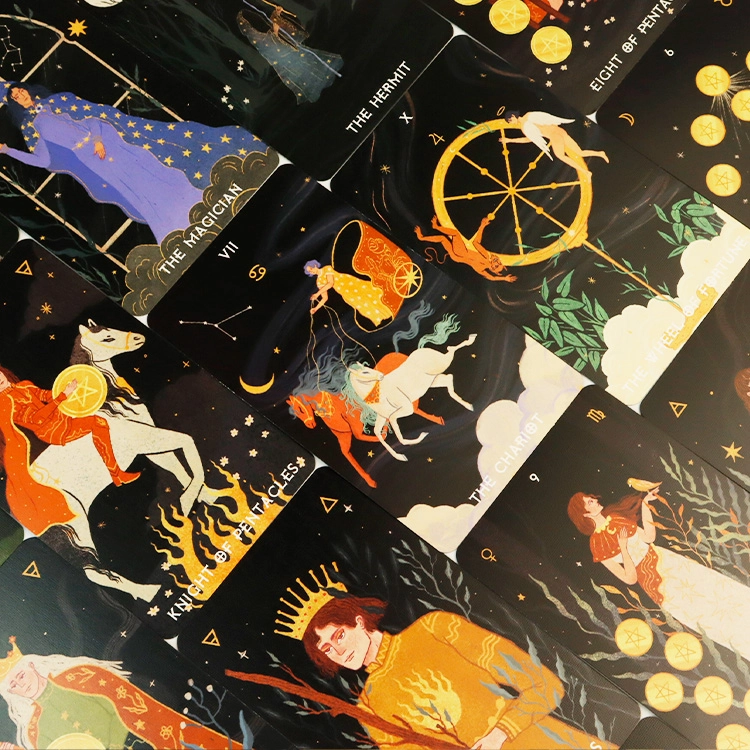
High Quality Tarot Cards with Sleeve Box Packaging | Premium Custom Tarot Deck Set for Enhanced Presentation & Protection
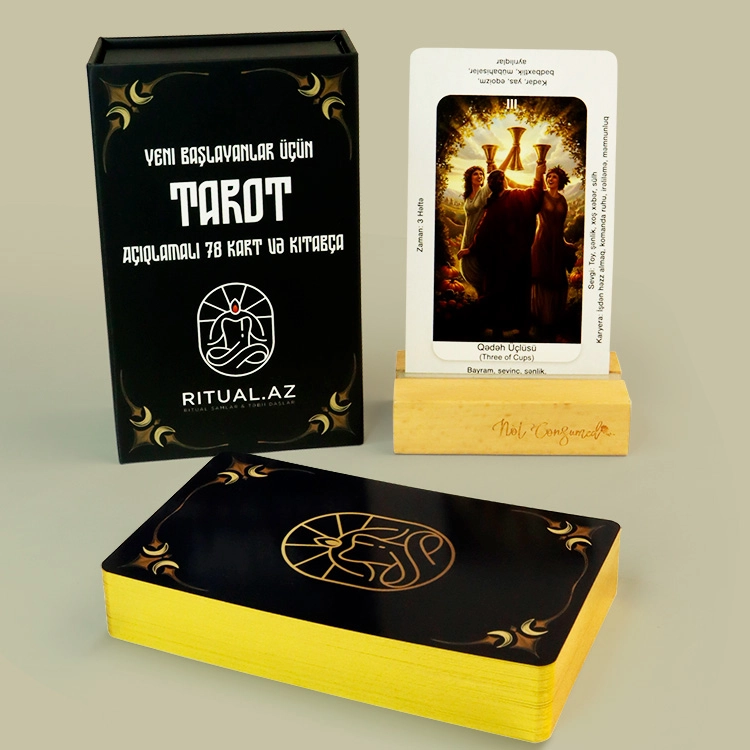
Hot Foil Stamped Tarot Cards with Book-Style Box | Premium Gold Edge Tarot Deck for Custom
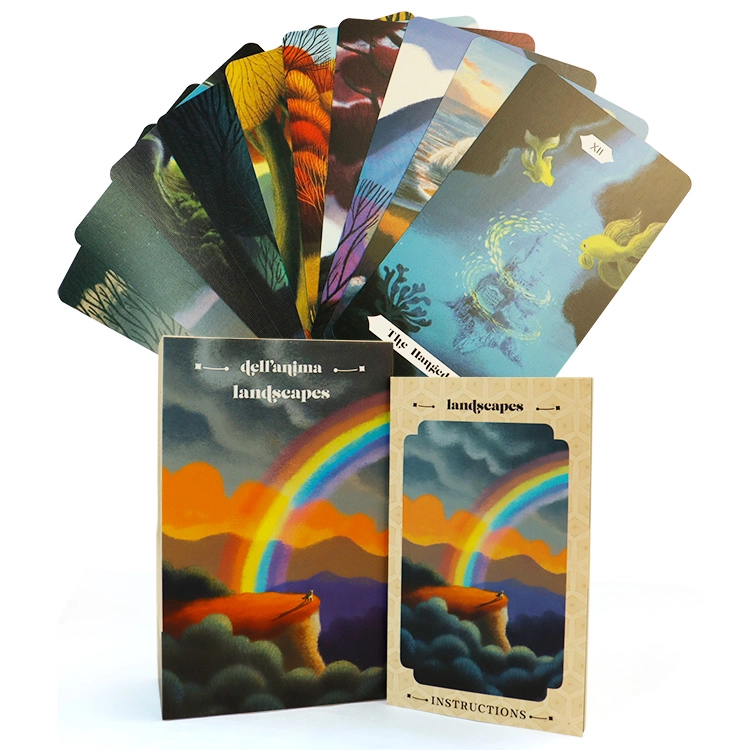
Rainbow Blue Edge Tarot Cards with lid and base Box | Custom Luxury Tarot Cards Deck Manufacturer
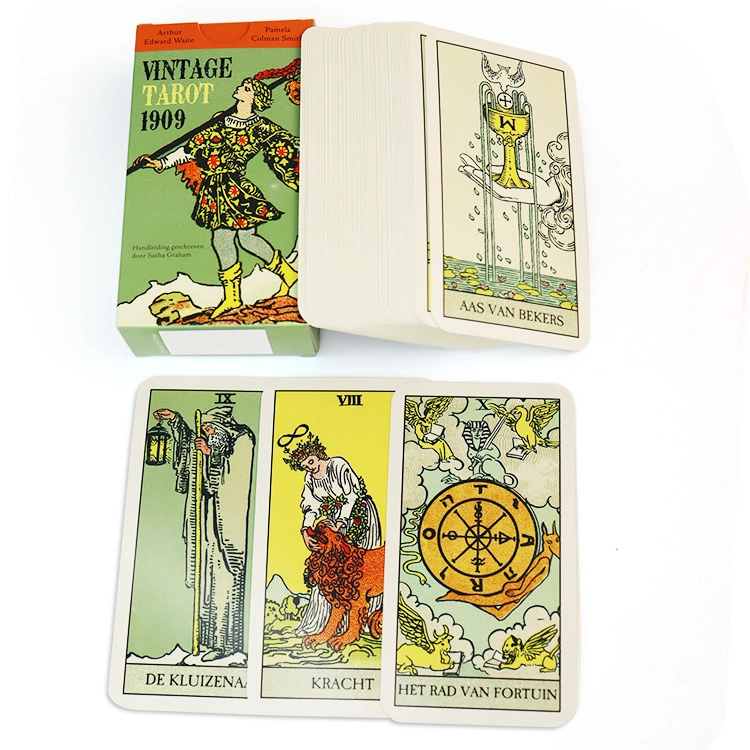
bbilaser
sq_AL