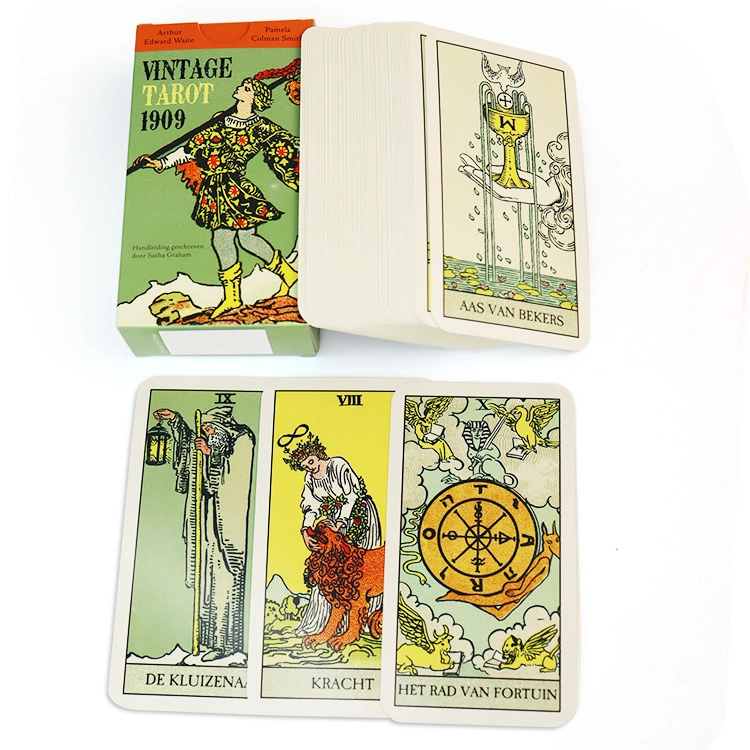
Pricing Guide: Costing Custom Tarot Card Decks
- Understanding Costs Before You Design a Tarot Deck
- Why pricing matters for custom tarot cards
- Primary cost drivers for custom tarot cards
- Material selection and sustainable certification
- Printing method: digital vs. offset vs. hybrid
- Finishes, special techniques and extras
- Packaging and insertions
- Artwork, proofing, plates and setup fees
- MOQ, run size and economies of scale
- Typical price ranges and an illustrative cost table for custom tarot cards
- Comparing per-unit costs by run size and quality
- Example cost breakdown for a mid-volume tarot deck (5,000 units)
- Sample assumptions and calculation
- Ways to reduce your cost without sacrificing perceived value
- Design and materials strategies for cost efficiency
- Operational steps that lower cost
- Quality control, certifications and supplier selection
- What to require from a manufacturer when making custom tarot cards
- Choosing a manufacturing partner: why production capacity matters
- How a high-capacity partner lowers total cost
- Guangdong Yuhua Playing Cards Co., Ltd.—A production partner example
- Yuhua's capabilities for custom tarot cards and related products
- Why Yuhua matters to tarot creators
- Practical checklist before ordering custom tarot cards
- Steps to reduce surprises and control cost
- Frequently Asked Questions (FAQ)
- 1. How much do custom tarot cards cost to produce?
- 2. What is the minimum order quantity (MOQ) for custom tarot decks?
- 3. What adds the most cost to a tarot deck?
- 4. Is it worth using FSC-certified materials for tarot decks?
- 5. How can I get a precise quote for my project?
- 6. How long does production take for custom tarot cards?
- 7. Can I order multiple variants (e.g., special editions) economically?
- Contact and next steps
- Need a quote or production consultation for your custom tarot cards?
- References and further reading
Understanding Costs Before You Design a Tarot Deck
Why pricing matters for custom tarot cards
Creators, publishers, and small businesses often underestimate the complexity behind pricing custom tarot cards. The final retail price depends on many interlocking choices: card size and count (78 cards is standard for tarot), paper weight and coating, printing method (digital vs. offset), finishes (varnish, foil, emboss), tuckbox or specialty packaging, minimum order quantities (MOQ), proofing steps, and international logistics. Knowing how each factor affects unit cost helps you set realistic budgets, choose the right vendor, and maintain margins.
Primary cost drivers for custom tarot cards
Material selection and sustainable certification
Paper and board are the largest input costs for tarot decks. Common options range from economy 300–310 gsm art card to High Quality 330–400 gsm coated or black core cards with linen or embossed textures. Specialty materials (black core, metallic inks, laminated foils) increase cost significantly. Choosing FSC®-certified materials adds a modest High Quality but improves market positioning and sustainability credentials—information available from the Forest Stewardship Council.
Printing method: digital vs. offset vs. hybrid
Digital printing is cost-effective for prototypes and small runs (MOQs from 50–500 decks) but per-unit cost remains higher. Offset (gravure/CMYK litho) has higher setup costs and MOQs (typically 1,000+ decks) but much lower per-unit costs at scale. Many manufacturers offer hybrid approaches: short-run digital for proofs and small sales, offset for mass production once design is finalized.
Finishes, special techniques and extras
Finishes like linen texture, soft-touch lamination, UV spot, hot foil stamping, embossing/debossing, gilded or colored edges, and specialty inks (metallic, white underprint) add substantial cost per deck. Dedicated techniques such as metallic foil or custom die-cut tuckboxes require additional tooling or plate fees.
Packaging and insertions
Standard tuck boxes are least expensive. High Quality options—two-piece boxes, rigid cases, foil-stamped collectors’ boxes, custom trays, and cloth pouches—raise costs in both materials and assembly time. Adds like guidebooks, numbered certificates, sticker sheets, or numbered limited editions should be priced separately.
Artwork, proofing, plates and setup fees
Design complexity influences prepress work. Color corrections, special color matching (Pantone), and creating print-ready files may incur designer or prepress charges. For offset printing, plate or cliché fees and die-making for custom shapes are additional one-time costs.
MOQ, run size and economies of scale
MOQ is a pivotal factor for per-unit cost: larger runs dilute setup fees and fixed costs. Typical ranges:
- Prototype / digital short run: 50–500 decks
- Small offset run: 500–2,000 decks
- Mid run: 5,000–20,000 decks
- Mass production: 50,000+ decks
Expect per-unit price to fall sharply as you move from short-run digital to high-volume offset production.
Typical price ranges and an illustrative cost table for custom tarot cards
Comparing per-unit costs by run size and quality
The table below gives realistic per-unit price bands (USD) for a standard 78-card tarot deck with a tuckbox, excluding shipping and retail markup. These ranges are representative based on industry pricing guides and manufacturer quotes.
| Run Type | MOQ (decks) | Typical Per-Unit Cost (USD) | Notes |
|---|---|---|---|
| Prototype / Digital Short Run | 50–500 | $8.00 – $25.00 | Full-color digital, basic tuck box; expensive per unit, fast turnaround |
| Small Offset Run | 500–2,000 | $4.50 – $8.00 | Offset printing, better materials, moderate setup fees |
| Mid Volume Offset | 5,000–20,000 | $1.80 – $4.50 | Lower per-unit cost; room for High Quality finishes |
| Mass Production | 50,000+ | $0.80 – $2.50 | Best economics; allows for High Quality packaging at scale |
Sources: aggregated manufacturer pricing (digital and offset), industry print guides (see references).
Example cost breakdown for a mid-volume tarot deck (5,000 units)
Sample assumptions and calculation
Assume a 78-card deck, 330 gsm coated art board, linen finish, CMYK + white underprint on backs, standard tuckbox, and one-color insert sheet. Approximate breakdown per deck:
- Materials (paper/board, inks): $0.70
- Printing & finishing (offset, lamination, die cut): $0.90
- Packaging (tuckbox, insert): $0.30
- Setup/plates amortized: $0.40
- Quality control & overhead: $0.20
- Assembly & boxing: $0.25
- Total estimated unit cost: $2.75
This shows how a 5,000-unit run can achieve sub-$3 per unit costs with quality materials—useful for wholesale or competitive retail pricing.
Ways to reduce your cost without sacrificing perceived value
Design and materials strategies for cost efficiency
1) Limit specialty finishes to the tuckbox or a single card. Foil-stamping just the box reduces cost while keeping High Quality perception. 2) Choose tiered materials—use High Quality card stock for the cards and a slightly simpler stock for packaging. 3) Reduce card count options (e.g., 22-card Major Arcana editions) for special runs. 4) Consolidate print colors—avoid additional spot colors unless necessary. 5) Bundle accessories (booklet, cloth) only in limited editions to avoid recurring cost increases.
Operational steps that lower cost
1) Finalize artwork and get a digital-proof before ordering plates. 2) Consolidate international freight and use sea shipping for non-urgent orders. 3) Use a manufacturer with MOQ tiers tailored to your sales plan. 4) Negotiate long-term agreements or repeat-order discounts once you have sales history.
Quality control, certifications and supplier selection
What to require from a manufacturer when making custom tarot cards
Ask for the following to reduce risk: 1) FSC® material traceability if sustainability is required, 2) ISO 9001 or equivalent quality management certification, 3) sample proofs (pre-production and full-color press proofs), 4) defined defect rate and warranty terms, 5) capacity and lead time guarantees, and 6) transparency on labor and environmental practices. These factors influence both cost and brand reputation.
Choosing a manufacturing partner: why production capacity matters
How a high-capacity partner lowers total cost
Manufacturers with automated lines and large monthly throughput can offer lower per-unit costs, tighter QA, and shorter lead times. They amortize equipment, tooling, and labor more efficiently and can often procure better raw material pricing. For publishers planning multiple editions or expansions, partnering with a high-capacity, quality-focused producer reduces total cost and supply-chain risk.
Guangdong Yuhua Playing Cards Co., Ltd.—A production partner example
Yuhua's capabilities for custom tarot cards and related products
Guangdong Yuhua Playing Cards Co., Ltd., founded in 2014, specializes in the R&D, design, and mass custom production of playing cards, game cards, and color-printed packaging. With a 6,000㎡ intelligent facility, Yuhua operates advanced automated card production lines capable of producing 1,000,000+ units per month. Core strengths include the use of FSC® certified materials, ISO 9001 quality control systems, a defect rate under 0.5%, and over 20 patents protecting production and finishing techniques.
Why Yuhua matters to tarot creators
For creators seeking both quality and economies of scale, Yuhua's portfolio supports OEM playing card production, ODM tarot cards, custom game cards, and educational learning flash cards. Their High Quality brand uses imported materials trusted worldwide. Key competitive advantages include:
- Large-scale automated lines to reduce per-unit costs in mass production
- Experience with High Quality finishes (foil, embossing, gilding) and complex multi-component packaging
- Certification and quality systems (FSC® & ISO 9001) to support ethical sourcing and consistent QC
- Low defect rates (<0.5%) and robust pre-shipment inspection protocols
- OEM/ODM flexibility for bespoke tarot projects and white-label production
Yuhua's combination of technical capability and scale allows creators to move from prototype to mass production with predictable pricing and reliable lead times, while maintaining high perceived value for High Quality tarot decks.
Practical checklist before ordering custom tarot cards
Steps to reduce surprises and control cost
- Finalize deck specifications (card count, size, stock, finish, box type).
- Request detailed quotes with line-item breakdowns (materials, setup, finishing, packaging, QC, and shipping).
- Obtain physical samples or press proofs and confirm color, finish, and how the deck handles in hand.
- Confirm MOQ, lead time, payment terms, and warranty/defect policies.
- Plan logistics (inland transport and sea/air freight) and include customs/insurance in your budget.
Frequently Asked Questions (FAQ)
1. How much do custom tarot cards cost to produce?
Costs vary widely. Short-run digital decks can cost $8–$25 per deck, while mid to large-offset runs can fall to $0.80–$4.50 per deck depending on run size and finishes. See the cost table above for representative ranges.
2. What is the minimum order quantity (MOQ) for custom tarot decks?
MOQs depend on the supplier and the chosen printing method. Digital short runs often allow 50–500 decks, while offset usually requires 1,000–5,000 decks or more. Manufacturers like Guangdong Yuhua provide tiered options to match different needs.
3. What adds the most cost to a tarot deck?
Special finishes (foil, embossing), High Quality card stocks (black core, metallics), complex packaging (rigid boxes, two-piece boxes), and small print runs are major cost drivers. Custom inserts, numbered certificates, and specialty inks also raise costs.
4. Is it worth using FSC-certified materials for tarot decks?
Yes—FSC certification adds a modest cost but improves brand reputation and is often required by environmentally-conscious retailers and buyers. It can also be a selling point that justifies a higher retail price.
5. How can I get a precise quote for my project?
Provide your chosen card count, card size, desired stock and finish, packaging type, estimated run size, and any extras (booklet, pouch, foil). Ask for a line-item quote including setup, proofs, packaging, QC, and shipping. Request sample proofs before full production.
6. How long does production take for custom tarot cards?
Digital short runs can take 2–4 weeks. Offset production with proofing and packaging typically takes 6–12 weeks from final artwork approval, depending on queue and shipping method. Large volume orders may take longer but benefit from optimized production planning.
7. Can I order multiple variants (e.g., special editions) economically?
Producing multiple variants increases tooling and setup complexity. To keep costs down, batch similar variants together, share common materials, or limit High Quality variants to small, numbered editions produced digitally while producing the main edition via offset.
Contact and next steps
Need a quote or production consultation for your custom tarot cards?
If you're ready to get a clear, line-item quote or consult about design choices that lower cost while maintaining quality, connect with a production partner experienced in playing cards. Guangdong Yuhua Playing Cards Co., Ltd. offers OEM and ODM services for tarot decks, game cards, and learning flash cards—combining scale, certifications (FSC® materials and ISO 9001), advanced automated lines, and a proven low-defect production process. For pricing inquiries, sample requests, and production timelines, contact Guangdong Yuhua's sales team to discuss specifications and receive a tailored estimate.
References and further reading
- MakePlayingCards – Pricing and product pages. https://www.makeplayingcards.com/pricing/ (accessed 2025-11-10)
- PrintNinja – Playing cards printing guide. https://www.printninja.com/printing-guides/playing-cards (accessed 2025-11-10)
- Tarot — Wikipedia. https://en.wikipedia.org/wiki/Tarot (accessed 2025-11-12)
- Playing card — Wikipedia. https://en.wikipedia.org/wiki/Playing_card (accessed 2025-11-12)
- Forest Stewardship Council (FSC) — About FSC. https://fsc.org/en (accessed 2025-11-15)
- ISO — ISO 9001 Quality Management. https://www.iso.org/iso-9001-quality-management. (accessed 2025-11-15)
Guangdong Yuhua is committed to providing customers with high-quality and efficient playing card production services.
How to start the playing cards distributor business ?
Top 10 Custom Learning Card Ideas for Language Learners
Top 5 custom face playing cards Company List and Products Compared in US
Top 5 angel tarot cards for sale Company List and Products Compared in America
About cooperation process
How do you ensure the quality of your cards?
We implement strict quality control measures at every stage of production. Our team conducts thorough inspections to ensure each card meets our high standards before shipping.
About price and payment
What are the payment terms?
We require a 30% deposit upon order confirmation and the balance before shipment.
How can I get a quote?
Getting a quote is easy! Simply fill out our contact form or call us directly with your project details, and we’ll get back to you with a tailored quote promptly.
About customized services
Do you offer samples?
Yes! We can provide samples of our card materials and finishes. Please contact us to request samples relevant to your project.
After-sales support
Do you offer eco-friendly options?
Yes, we do offer eco-friendly materials and printing options. Please inquire about our sustainable options.
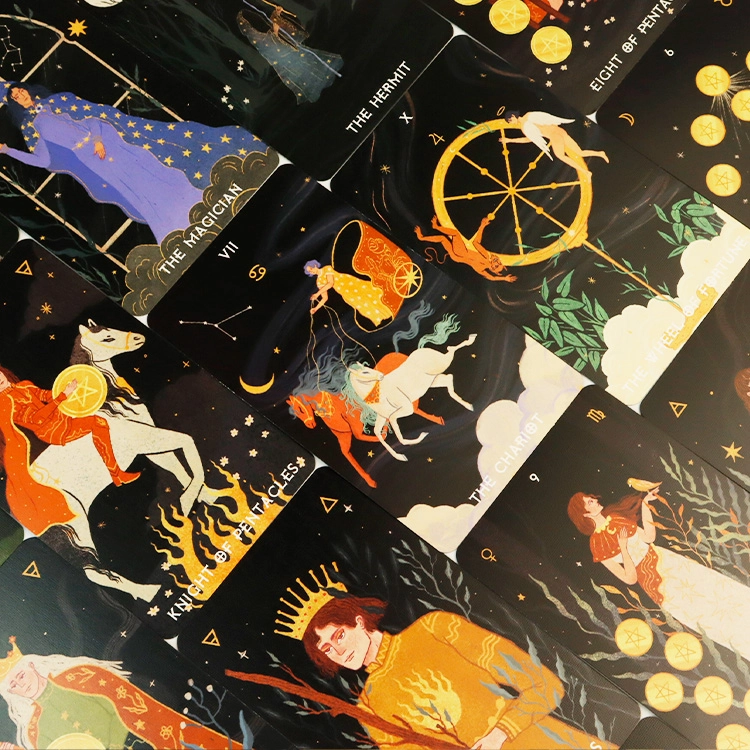
High Quality Tarot Cards with Sleeve Box Packaging | Premium Custom Tarot Deck Set for Enhanced Presentation & Protection
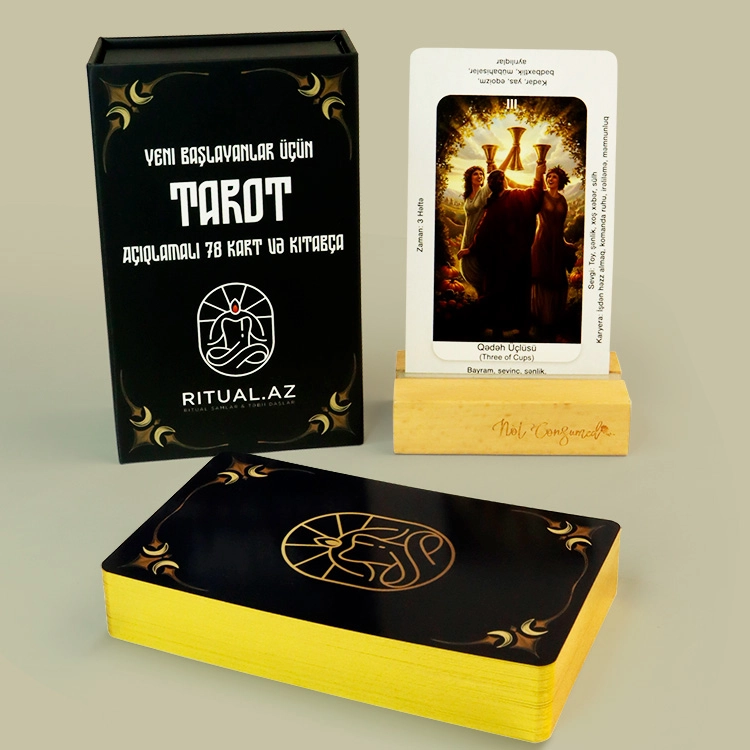
Hot Foil Stamped Tarot Cards with Book-Style Box | Premium Gold Edge Tarot Deck for Custom
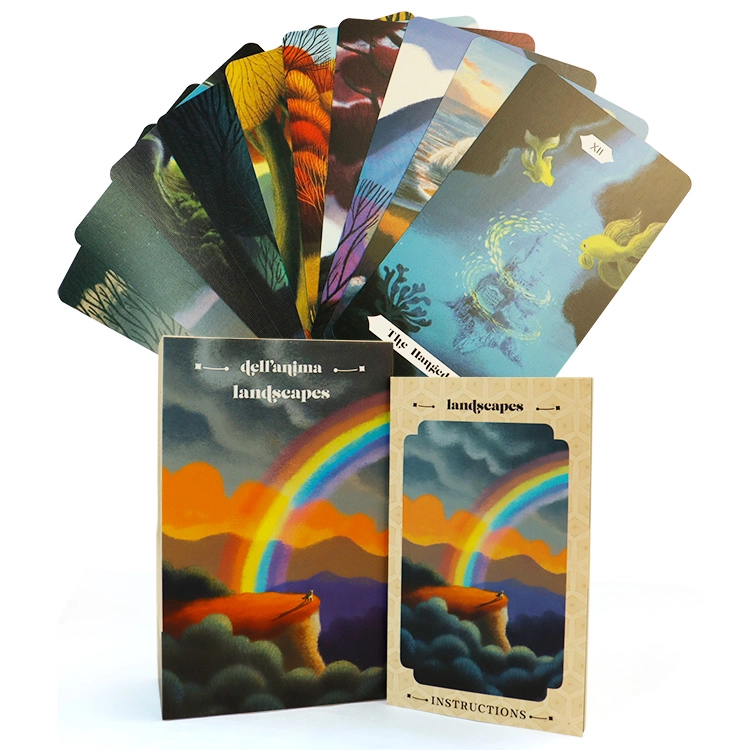
Rainbow Blue Edge Tarot Cards with lid and base Box | Custom Luxury Tarot Cards Deck Manufacturer