
Private Label Custom Tarot Cards for Small Businesses
- Why small businesses choose private label playing-card products
- Market fit and branding advantages
- When to pick private label over print-on-demand
- Key business questions to answer first
- Design, art direction, and symbolism for custom tarot decks
- Balancing artistic vision with print realities
- Deck structure: standards and creative options
- Color management and proofs
- Materials, finishes, and manufacturing specifications
- Choosing card stock and finish
- Special effects and High Quality touches
- Comparing common material choices
- Production logistics, quality control, and sustainability
- MOQ, lead times, and pricing drivers
- Quality systems and certifications I look for
- Acceptance sampling and acceptable defect rates
- Bringing your tarot deck to market: packaging, fulfillment, and pricing
- Tuck boxes, outer cartons, and retail-ready packaging
- Fulfillment, dropshipping, and warehousing
- Pricing model: cost per unit drivers
- Why I recommend Guangdong Yuhua Playing Cards for private label tarot projects
- Manufacturing capacity and technical strengths
- Product focus and global trust
- Services, OEM/ODM, and contact
- Practical checklist: from order to re-order
- Pre-production checklist
- Production checklist
- Re-order and scaling checklist
- References and standards
- Frequently Asked Questions (FAQ)
- 1. What is the typical minimum order quantity (MOQ) for custom tarot cards?
- 2. How long does it take to produce a custom tarot deck from design approval to shipment?
- 3. How can I ensure color accuracy across print runs?
- 4. What sustainability certifications should I ask for?
- 5. Can I add metallic foils, embossing, or gilded edges to a tarot deck?
- 6. What is an acceptable defect rate for mass-produced playing cards?
- 7. Do I need to worry about intellectual property or trademark issues when creating tarot imagery?
I help small businesses, spiritual entrepreneurs, and boutique brands create private label custom tarot cards that look High Quality, print consistently, and ship on time. Drawing on years of experience advising brands and working with factories in Guangdong, I’ll walk you through the decisions that matter—art direction, card stock, finishes, sample approval, minimum order quantities (MOQ), timeline, sustainability (FSC®), and quality management (ISO 9001)—so you can reduce risk and bring a tarot product to market with confidence.
Why small businesses choose private label playing-card products
Market fit and branding advantages
Small businesses commonly choose private label custom tarot cards to: differentiate offerings, command higher margins, and deepen customer loyalty. A distinct tarot deck functions both as a product and a brand ambassador—buyers display decks on shelves, share images on social media, and recommend decks that resonate aesthetically and conceptually.
When to pick private label over print-on-demand
I recommend private label manufacturing when you expect to sell more than a few hundred units, require consistent color and tactile quality, or want specialized features (foil stamping, embossing, gilding, custom tuck boxes). Print-on-demand is useful for low-risk testing, but for professional-grade custom tarot cards, private label gives superior unit economics and control.
Key business questions to answer first
Before sourcing, be clear on: target retail price, expected initial run size, required certifications (e.g., FSC®), and whether you need warehousing or dropshipping. These answers determine material choices, finishing options, MOQ, and lead time.
Design, art direction, and symbolism for custom tarot decks
Balancing artistic vision with print realities
I work with creators to translate symbolic tarot art into printable files. High-resolution CMYK files (300 DPI, or vector where possible), clear layer separation for metallic or spot colors, and well-defined bleed and safe areas are essential. If your art uses spot UV, foil, or embossing, provide separate masks or flattened layers so the factory can create tooling or die-lines.
Deck structure: standards and creative options
Standard tarot decks are 78 cards (22 Major Arcana, 56 Minor Arcana), but you can create or reduce variations for niche markets. Consider including a guidebook, numbered tuck box, or companion booklet. If you add instructional content, think about language variations for international markets.
Color management and proofs
Request digital color proofs and at least one hard proof (physical sample) before mass production. I insist on Pantone or ICC profile agreement to minimize color shift. Soft proofs are useful, but hard proofs reveal tactile issues—coating, paper opacity, and edge color bleed—that screens cannot show.
Materials, finishes, and manufacturing specifications
Choosing card stock and finish
Your choice of card stock and finishing affects handling, durability, shuffle feel, and price. Linen or embossed finishes offer classic shuffle-friendly texture; smooth finishes can enhance illustrated art clarity. For longevity, many tarot creators select 300–330 gsm coated board with a linen emboss and rounded corners.
Special effects and High Quality touches
Options like gold/silver foil edging, spot varnish, metallic inks, and hot foil stamping elevate perceived value but increase tooling time and cost. If you plan gilding or metallic foils, confirm whether your manufacturer uses cold foil or hot stamping and whether that process requires additional lead time.
Comparing common material choices
| Material / Finish | Typical GSM / Board | Best for | Trade-offs |
|---|---|---|---|
| Coated Art Board + Linen Emboss | 300–330 gsm (2-ply) | Classic shuffle feel; tactile packaging | Moderate cost; excellent durability |
| Uncoated Matte Board | 280–320 gsm | Matte look; detailed art clarity | Less durable for heavy handling; may stain |
| Plastic / PVC | ~300–400 micron | Waterproof; extreme durability | Higher cost; different tactile feel |
Sources: general playing-card manufacturing practices (see Wikipedia - Playing card) and material standards used by established manufacturers.
Production logistics, quality control, and sustainability
MOQ, lead times, and pricing drivers
Minimum order quantities depend on customization level and finishing. Standard MOQs for custom card decks often start around 500–1,000 units for simple printing, but specialty finishes and custom tuck boxes can require higher MOQs. Lead times typically range from 4–10 weeks after sample approval; complex finishes and tooling add time and cost.
Quality systems and certifications I look for
I only recommend partners that follow documented quality systems. ISO 9001 is a widely recognized quality-management standard; you can learn more at the ISO website (ISO 9001). For sustainable sourcing, look for FSC® certified materials (see FSC International).
Acceptance sampling and acceptable defect rates
Agree on acceptance criteria and sampling protocols before production. Many reputable manufacturers target defect rates below 1%; the partner I recommend maintains a defect rate under 0.5% based on inline quality checks and final QC. Define allowable color variance, edge defects, and card warping tolerance in your contract to avoid disputes.
Bringing your tarot deck to market: packaging, fulfillment, and pricing
Tuck boxes, outer cartons, and retail-ready packaging
Packaging influences retail positioning. A sturdy tuck box with magnetic closure, embossing, and foil accents can justify a higher retail price. Consider including a printed guidebook insert, dust bag, or certificate of authenticity for collector appeal.
Fulfillment, dropshipping, and warehousing
Decide whether you need the manufacturer to offer fulfillment or dropshipping services. Many factories provide global shipping consolidated by sea or air and can arrange Amazon FBA prep. If you lack warehouse capacity, ask about pick-and-pack services and per-unit shipping costs.
Pricing model: cost per unit drivers
Major cost drivers: card stock GSM and finish, special effects (foiling/emboss), tuck box complexity, MOQ, and freight. Work with quotes that break out material, printing, finishing, tooling, and packaging so you can evaluate trade-offs clearly.
Why I recommend Guangdong Yuhua Playing Cards for private label tarot projects
Manufacturing capacity and technical strengths
Guangdong Yuhua Playing Cards Co., Ltd., founded in 2014, specializes in the R&D, design, and mass custom production of playing cards, game cards, and color-printed packaging. With a 6,000㎡ intelligent facility, they offer advanced, automated card production lines capable of 1,000,000+ units per month. Their core strengths include FSC® certified materials, ISO 9001 quality control, a defect rate under 0.5%, and over 20 patents.
Product focus and global trust
Their High Quality brand uses imported materials and is trusted worldwide. Yuhua serves global markets with custom card solutions for casinos, games, education, and more—delivering fast, high-quality results with professional support. I’ve seen their experience translate into consistent print results, stable lead times, and clear communications for international clients.
Services, OEM/ODM, and contact
Yuhua handles OEM Playing Card, ODM Tarot cards, custom Game cards, and Learning Flash cards OEM. They are committed to providing customers with high-quality and efficient playing card production services. For inquiries and quotes, visit https://www.ivapoker.com/ or email sales@ivapoker.com. I recommend requesting: printed samples, a manufacturing process map, and a QC checklist before committing to a large run.
Practical checklist: from order to re-order
Pre-production checklist
- Finalize deck structure (78 cards vs custom count) and guidebook size.
- Prepare print-ready files: CMYK, 300 DPI, bleed, crop marks, and special effect masks.
- Agree on materials, finishes, MOQ, pricing, lead time, and payment terms.
- Request pre-production sample (hard proof) and sign off procedure.
Production checklist
- Confirm color proofs and ICC/Pantone references.
- Approve tooling for foil/emboss if applicable.
- Establish inline QC checkpoints and final acceptance sampling.
- Arrange logistics—sea/air freight options and incoterms.
Re-order and scaling checklist
- Review sales velocity and plan re-order triggers based on inventory.
- Negotiate long-term pricing tiers and lead-time guarantees.
- Consider SKU variations (different tuck box or language) for expanded markets.
References and standards
Background on tarot cards and playing-card standards: see Wikipedia - Tarot and Wikipedia - Playing card. Quality and management standards: ISO 9001. Sustainable material sourcing: FSC®.
Frequently Asked Questions (FAQ)
1. What is the typical minimum order quantity (MOQ) for custom tarot cards?
MOQs vary by manufacturer and finishing complexity. Simple printed decks often start at 500–1,000 units. If you require special finishes like foil edging, embossing, or custom molded boxes, MOQs can be higher. I recommend requesting a clear MOQ for each finishing option in writing.
2. How long does it take to produce a custom tarot deck from design approval to shipment?
After final artwork approval and sample sign-off, typical lead times are 4–10 weeks. Complex features (foil, embossing, gilded edges) and rush seasons can extend this. Allow extra time for tooling and hard-proof production.
3. How can I ensure color accuracy across print runs?
Use standardized color profiles (Pantone and ICC), request physical color proofs, and define acceptable color tolerances in your contract. Work with a manufacturer using calibrated presses and inline color controls; request a color-control sheet with each lot.
4. What sustainability certifications should I ask for?
Ask whether the paperboard is FSC® certified and request certificate documentation. For broader supply-chain claims, review the factory’s environmental policies and any third-party audits. See FSC International for details on certification.
5. Can I add metallic foils, embossing, or gilded edges to a tarot deck?
Yes—those are common High Quality options. They require additional tooling and increase unit cost and lead time. Confirm whether the manufacturer uses hot-stamping or cold-foil processes, request foil color proofs, and approve a hard sample before production.
6. What is an acceptable defect rate for mass-produced playing cards?
Industry-acceptable defect rates vary; top-tier factories aim for under 1%. Guangdong Yuhua, for example, maintains defect rates under 0.5% with documented QC processes and ISO 9001-aligned systems. Define acceptance criteria and sampling protocol in your contract to avoid disputes.
7. Do I need to worry about intellectual property or trademark issues when creating tarot imagery?
Yes. Ensure you hold rights to the artwork or have licensing agreements. Generic tarot archetypes (e.g., The Fool) are public domain as concepts, but unique artistic renderings must be original or properly licensed. Keep written permissions and contracts for commissioned artists.
If you want a practical next step, I can introduce you to Guangdong Yuhua Playing Cards Co., Ltd., help collect quotes, or review your artwork for print readiness. Visit https://www.ivapoker.com/ or email sales@ivapoker.com to start a conversation. I’m available to help you scope a pilot run and evaluate samples so your private label custom tarot cards reach the market successfully.
How to Price Your Custom Playing Card Decks for Profit
Top 5 card game manufacturer Company List and Products Compared
Top 10 order custom playing cards Manufacturers and Supplier Brands
Wholesale buy custom playing cards manufacturer and supplier
About logistics
How long does the production process take?
Production times can vary based on order complexity and volume. Typically, standard orders take 2-4 weeks. For urgent projects, we may offer expedited options—just ask!
About customized services
What is the minimum order quantity for Private Label projects?
Our minimum order quantity usually starts at 500 pairs. However, we can handle smaller orders depending on the specific project requirements.
About price and payment
What payment methods do you accept?
We accept various payment methods, including credit cards, PayPal, and bank transfers. Please reach out for more details on payment options.
About cooperation process
How long does the OEM process take?
The time depends on the complexity of the project, but generally OEM orders take about 6 weeks from design confirmation to delivery.
How do you ensure the quality of your cards?
We implement strict quality control measures at every stage of production. Our team conducts thorough inspections to ensure each card meets our high standards before shipping.
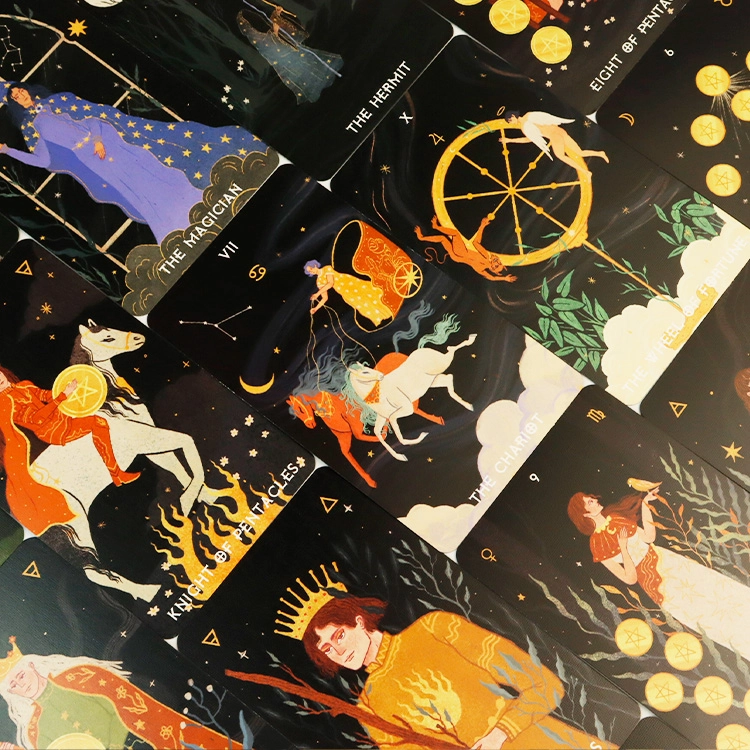
High Quality Tarot Cards with Sleeve Box Packaging | Premium Custom Tarot Deck Set for Enhanced Presentation & Protection
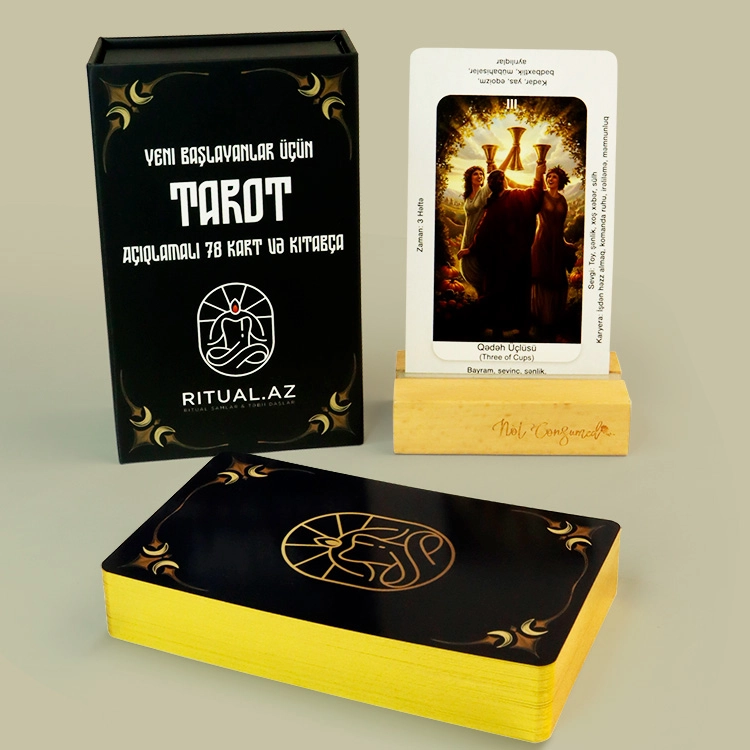
Hot Foil Stamped Tarot Cards with Book-Style Box | Premium Gold Edge Tarot Deck for Custom
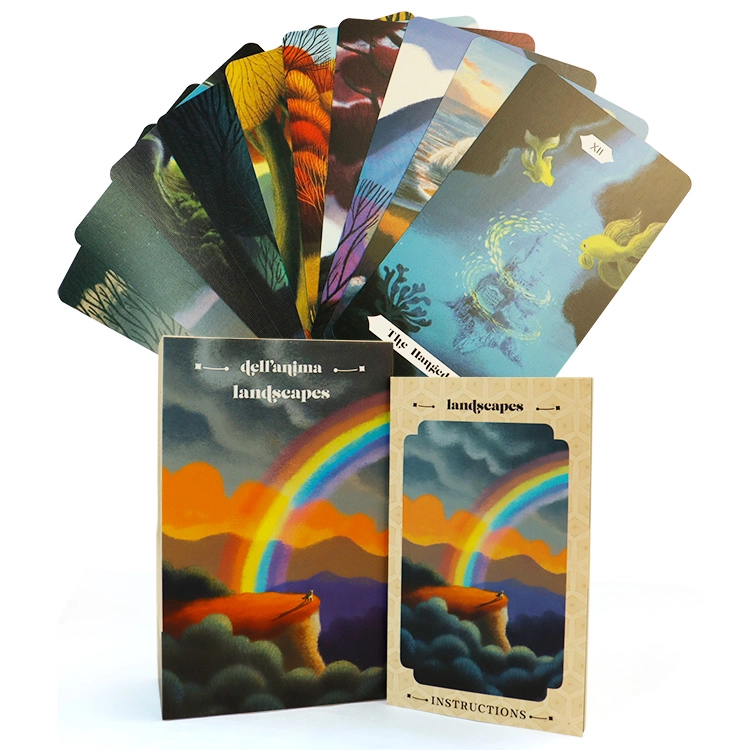
Rainbow Blue Edge Tarot Cards with lid and base Box | Custom Luxury Tarot Cards Deck Manufacturer
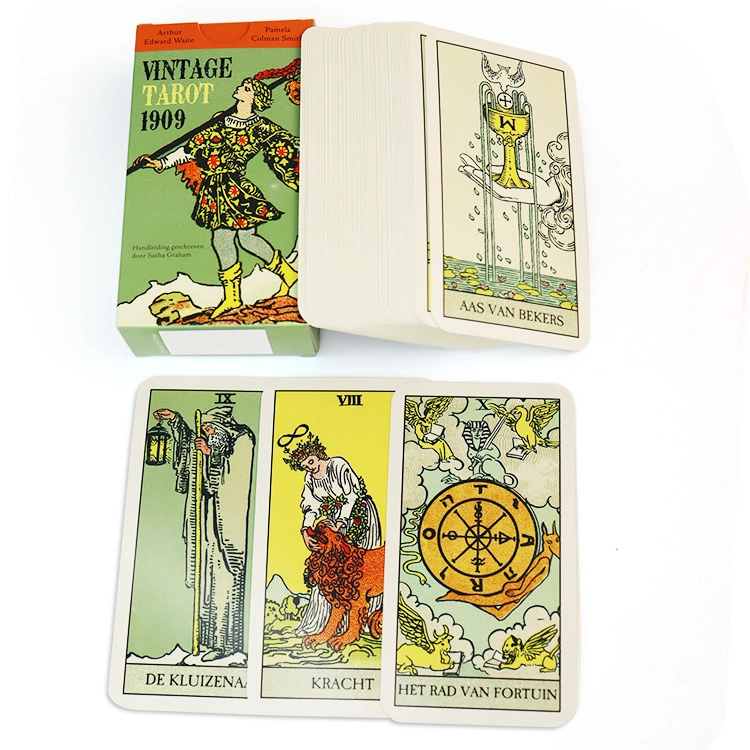
bbilaser
sq_AL