
PVC vs. PET Playing Cards: The Ultimate Material Comparison Guide (2026)
In the world of professional gaming, magic, and cardistry, the debate over materials is never-ending. For decades, the industry standard for premium decks has shifted away from traditional paper stock toward synthetic polymers. However, as we move through 2026, a new nuance has emerged in the manufacturing sector: the rivalry between PVC vs PET playing cards.
Choosing the best material for custom playing cards is no longer just about aesthetics; it is an engineering decision involving tactile feedback, chemical resistance, and return-on-investment (ROI). Whether you are a casino procurement manager looking for longevity or a designer launching a Kickstarter campaign, understanding the molecular and functional differences between Polyvinyl Chloride (PVC) and Polyethylene Terephthalate (PET) is critical.
This guide provides a deep dive into casino grade card specs, plastic playing cards durability, and the crucial card snap back test to help you make an informed decision for your next project.
- Introduction: Why Material Choice Matters for Custom Decks
- Technical Specifications Comparison
- Thickness Standards: Standard 0.3mm vs. Casino-Grade 0.32mm
- Texture & Finish: Matte vs. Glossy
- Opacity Levels: Security Under the Spotlight
- Weight & Density
- Handling & Performance: The 'Snap-Back' Test
- What is 'Snap-Back'?
- The Shuffling Experience
- Friction & Glide
- Warping Resistance
- Durability & Environmental Stress Tests
- Waterproof Capabilities
- Scratch & Scuff Resistance
- Edge Chipping
- Chemical Resistance
- Printing Compatibility & Customization
- Offset vs. UV Printing
- Color Vibrancy
- Special Finishes
- Safety, Compliance, and Certifications
- Understanding EN71 and ASTM
- Eco-friendliness and Recyclability
- Final Verdict: Which Material Should You Choose?
- Best for Casinos & Poker Rooms: PVC
- Best for Promotional Gifts & Casual Games: PET
- Price vs. Performance Matrix
- FAQs
Introduction: Why Material Choice Matters for Custom Decks
The era of paper cards dominating the professional scene is largely behind us. While paper retains a nostalgic charm and is preferred for certain magic manipulations, the shift to 100% plastic for professional use—specifically in poker rooms and casinos—is absolute. Plastic cards do not crease, mark, or degrade nearly as fast as their cellulose counterparts.
However, "100% Plastic" is a vague term. It usually refers to two distinct polymers:
1. PVC (Polyvinyl Chloride): A flexible, durable plastic known for its soft feel and high density. It has long been the gold standard for high-end poker decks (like KEM or Copag).
2. PET (Polyethylene Terephthalate): A stiffer, more eco-friendly plastic often found in beverage bottles but increasingly used for promotional and budget-friendly playing cards.
In this article, we will dissect the technical specifications, perform a rigorous performance analysis, and determine which material offers the best value. We will explore why PVC vs PET playing cards behave differently under the stress of a shuffle and which one survives the dreaded "drink spill" at the gaming table.
Technical Specifications Comparison
To the untrained eye, two plastic cards may look identical. However, under the microscope and calipers, the differences become glaring. These specs define the "hand feel" that players obsess over.
Thickness Standards: Standard 0.3mm vs. Casino-Grade 0.32mm
The thickness of a playing card is measured in millimeters or microns.
· PET Cards: Typically manufactured at a standard thickness of 0.25mm to 0.3mm. Because PET is naturally stiffer, manufacturers often make the cards thinner to allow for shuffling. However, this can sometimes make the cards feel flimsy or "sharp" on the edges.
· PVC Cards: These generally range from 0.3mm to 0.32mm. The casino grade card specs almost exclusively demand 0.31mm or 0.32mm PVC. This extra thickness provides a substantial weight and "thud" when the card hits the felt.
Texture & Finish: Matte vs. Glossy
The finish of the card dictates how it slides across the table (glide) and how it grips against other cards (friction).
· PVC: Highly adaptable to complex texturing. PVC accepts "linen" or "air-cushion" embossing very well, which creates pockets of air between cards for smoother fanning. Deep matte finishes are easier to achieve on PVC, reducing glare.
· PET: Tends to have a naturally slicker, glossier surface. While matte coatings can be applied, PET cards often feel "slippery" straight out of the box. If the texture isn't aggressive enough, a stack of PET cards can slide off a uneven table easily.
Opacity Levels: Security Under the Spotlight
One of the biggest fears in a casino environment is "bleed-through"—where strong overhead lighting reveals the suit or rank of a card through its back.
· PVC: Due to its density and the ability to layer opacity inks (white block-out layers) effectively, PVC offers superior opacity. It is completely opaque, ensuring game integrity.
· PET: Naturally more transparent. To achieve casino grade card specs regarding opacity, PET cards require heavier layers of opaque white ink during printing. Lower-quality PET decks often fail this test, allowing a shadow of the face card to be seen from the back under a halogen light.
Weight & Density
Grammage affects the perception of quality. PVC is denser than PET. A standard deck of PVC cards will weigh significantly more than a PET deck of the same dimensions. This added weight conveys luxury and helps the cards fly straight when pitched by a dealer.
Handling & Performance: The 'Snap-Back' Test
The true test of a playing card is not how it looks, but how it shuffles. This brings us to the most critical metric in our comparison: the card snap back test.
What is 'Snap-Back'?
Snap-back, or "memory," is the material's ability to return to its original flat state after being bent. When a player peeks at their hole cards in Texas Hold'em, they bend the corner up. A card with poor memory will stay bent (marking the card). A card with excellent memory snaps flat instantly.
· PVC Performance: PVC excels here. It has a "soft" elasticity. You can bend a PVC card nearly 90 degrees, and it will spring back flat without a crease line. This makes it the best material for custom playing cards intended for serious poker.
· PET Performance: PET is rigid. While strong, it lacks the elastic memory of PVC. If bent past a certain threshold, PET is prone to "whitening" (stress marks) or retaining a slight curve. It feels stiffer to shuffle and requires more force to riffle.
The Shuffling Experience
· Softness vs. Stiffness: PVC feels softer and creamier in the hand. It absorbs the energy of the shuffle, making the riffle quiet and smooth. PET feels "clicky" and loud. The stiffness of PET can make the bridge of a shuffle difficult for people with smaller hands or weaker grips.
Friction & Glide
For a dealer fanning the deck across the table, the coefficient of friction is key. PVC's surface texture allows for a controlled glide—the cards spread evenly. PET, being harder and often smoother, can result in "clumping" where packets of cards stick together due to static electricity or surface vacuum, or conversely, slide uncontrollably.
Warping Resistance
Plastic is sensitive to heat.
· PVC: Can warp if left in extreme heat (like a car dashboard in summer), but generally stable in room temperature.
· PET: Has a higher heat tolerance than PVC. It is less likely to warp in hot, humid climates, making it a decent choice for outdoor gaming environments.
Durability & Environmental Stress Tests
When investing in a custom deck, you want it to last. We analyzed plastic playing cards durability through a series of stress tests.
Waterproof Capabilities
Both materials produce excellent waterproof playing cards. Unlike paper, which swells and delaminates instantly upon contact with moisture, both PVC and PET are hydrophobic.
· Immersion Test: We submerged both decks in water for 24 hours. Neither absorbed water.
· The Difference: The difference lies in the cleaning. PVC can be wiped down with a damp cloth easily. However, because PVC is slightly porous on a microscopic level, it can stain if exposed to strong dyes (like red wine) for long periods. PET is more chemical resistant and less likely to stain.
Scratch & Scuff Resistance
· PET: Being a harder plastic, PET is highly resistant to surface scratches from fingernails or table grit. The gloss remains shiny longer.
· PVC: Being softer, PVC is more prone to micro-scratches over months of heavy use. However, these scratches often help break the deck in, improving the glide, whereas scratches on PET can make the cards feel rough.
Edge Chipping
After 500+ shuffles, cards begin to degrade at the edges.
· PVC: Maintains a pristine edge for a very long time. It wears down gradually and evenly.
· PET: Because it is rigid, the edges can become brittle. Under heavy aggressive shuffling, PET cards are more likely to develop microscopic cracks or chips along the edge, which can snag on the felt layout.
Chemical Resistance
In a post-pandemic world, sanitizing cards is routine.
· PVC: Care must be taken. Strong solvents (acetone, high-concentration alcohol) can dissolve the surface finish or ink of PVC cards. Mild soap and water are recommended.
· PET: Highly resistant to alcohol and sanitizers. You can clean PET cards more aggressively without damaging the plastic matrix.
Printing Compatibility & Customization
For creators seeking the best material for custom playing cards, print fidelity is non-negotiable.
Offset vs. UV Printing
· PVC: PVC is a printer's dream. It has high surface energy, meaning inks bond (anchor) to it aggressively. This allows for deep, rich colors and sharp offset printing results. The ink becomes "part" of the card.
· PET: PET has low surface energy. It often requires a chemical primer or Corona treatment before printing so the ink sticks. Without this, the ink can flake off over time. UV printing is preferred for PET to cure the ink instantly onto the surface.
Color Vibrancy
PVC tends to yield warmer, more saturated colors. PET, due to its slight translucency and brightness, renders colors vividly but sometimes with a "cooler" or harsher tone.
Special Finishes
If you want foil stamping (Gold/Silver) or Spot UV:
· PVC: Hot stamping works beautifully as the material tolerates the heat and pressure, embedding the foil into the card.
· PET: Can be difficult to hot stamp without distorting the card due to its rigidity. Cold foil techniques are often required, which are more expensive.
Safety, Compliance, and Certifications
When selling globally, you must adhere to safety standards.
Understanding EN71 and ASTM
· EN71 (Europe) & ASTM F963 (USA): Both standards regulate the safety of toys, specifically heavy metal migration and toxins.
· Compliance: Reputable manufacturers can produce both PVC and PET that are fully compliant. However, standard PVC historically contains phthalates (plasticizers) to make it flexible.
· The Shift: Modern casino grade card specs mandate "Non-Toxic PVC" or "Phthalate-Free PVC." When ordering custom decks, you must specify this to ensure compliance with Western markets.
Eco-friendliness and Recyclability
· PET: The clear winner for the environment. PET (Recycle Code #1) is the most recycled plastic in the world. It is easier to reclaim and repurpose than PVC.
· PVC: (Recycle Code #3) is harder to recycle and releases chlorine if incinerated improperly.
· The Counter-Argument: While PET is greener to produce, plastic playing cards durability means a single PVC deck can last 50 times longer than a paper deck, and 2-3 times longer than a cheap PET deck. Longevity is its own form of sustainability.
Final Verdict: Which Material Should You Choose?
In the battle of PVC vs PET playing cards, there is no single winner—only the right tool for the job.
Best for Casinos & Poker Rooms: PVC
If your goal is performance, handling, and luxury, PVC is the undisputed king.
· Why: The card snap back test results prove it handles abuse without marking. The 0.32mm thickness feels premium, and the soft texture allows for perfect dealing.
· Recommendation: Choose 100% PVC, 0.32mm, Matte Finish.
Best for Promotional Gifts & Casual Games: PET
If your goal is cost-efficiency, eco-marketing, or cards that will be used outdoors/near pools.
· Why: PET provides waterproof playing cards at a lower price point. They are rigid, shiny, and withstand humidity well. They are perfect for travel decks or brand giveaways where professional shuffling mechanics are secondary to durability.
· Recommendation: Choose 0.30mm PET, Glossy Finish.
Price vs. Performance Matrix
· PVC: Higher Cost ($$$) -> Highest Performance -> High Durability.
· PET: Lower Cost ($) -> Moderate Performance -> High Stiffness.
By considering specific metrics like thickness (0.3mm vs 0.32mm) and certification standards (EN71/ASTM), you can ensure your custom deck not only looks premium but performs flawlessly at the table.
FAQs
What is the difference between PVC and PET playing cards regarding handling?
PVC cards are generally softer with better 'snap-back' (memory), making them easier to shuffle and riffle. PET cards tend to be stiffer and more rigid, which some casual users might find harder to handle but others prefer for their firm feel.
Are PVC playing cards waterproof?
Yes, both 100% PVC and PET playing cards are fully waterproof and washable. Unlike paper cards, they can be submerged in water or wiped down with a damp cloth without warping or delaminating.
Which plastic card material is better for casino use?
Casinos typically prefer high-grade PVC (often 0.31mm or 0.32mm thickness) because it offers superior durability, opacity (security), and retains its shape after thousands of shuffles, unlike lower-grade plastics that may crack.
Are plastic playing cards eco-friendly?
While both are plastics, PET is generally considered more environmentally friendly and easier to recycle than PVC. However, the long lifespan of plastic cards (outlasting paper decks by 50x) contributes to waste reduction over time.
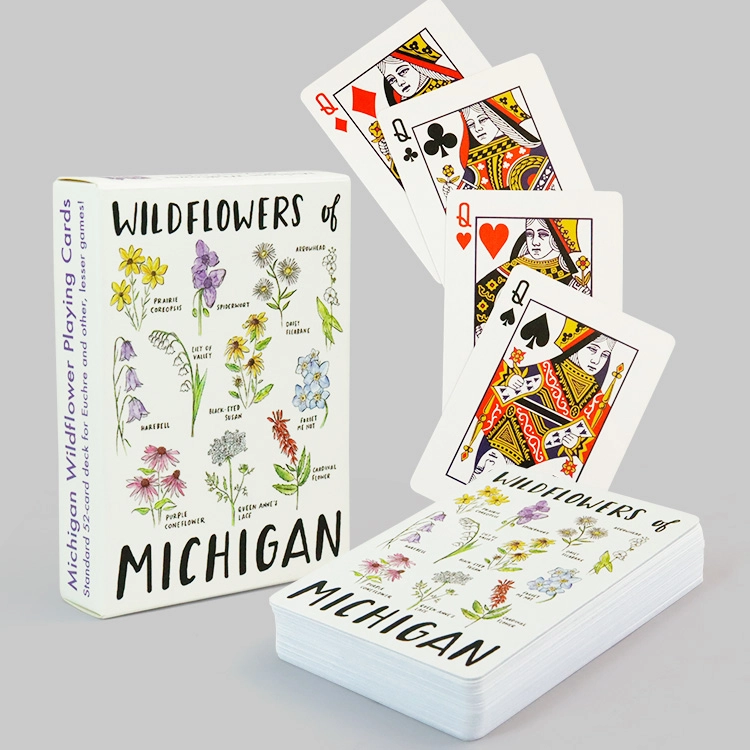
The Curated Wild: A Lifestyle Brand's Statement Piece – The Power of Custom Wildflower Playing Cards
Custom Poker Card Printing: How to Choose a Professional Manufacturer for Your Brand
How to Create Your Own Custom Playing Cards: A Step-by-Step Design Tutorial (2026 Edition)
Beyond KEM: The 10 Best Professional Poker Card Brands You Didn't Know About (2026 Edition)
Custom Design Playing Cards: The Ultimate 2026 Guide to Manufacturing and Artistry
After-sales support
Do you offer eco-friendly options?
Yes, we do offer eco-friendly materials and printing options. Please inquire about our sustainable options.
About cooperation process
How long does the OEM process take?
The time depends on the complexity of the project, but generally OEM orders take about 6 weeks from design confirmation to delivery.
About logistics
Can you handle shipping and fulfillment?
Yes! We offer comprehensive fulfillment services, including storage, packing, and shipping. You can rely on us to ensure your cards reach their destination safely and on time.
About customized services
Do you offer samples?
Yes! We can provide samples of our card materials and finishes. Please contact us to request samples relevant to your project.
About price and payment
What payment methods do you accept?
We accept various payment methods, including credit cards, PayPal, and bank transfers. Please reach out for more details on payment options.


WE’D LOVE TO  HEAR
HEAR
FROM YOU
Please send us your inquiry details; our team will contact you ASAP.
20+ years of experience in custom playing cards, game cards, tarot cards, flashcards, and board games, as well as paper and paperboard box manufacturing.