
The Ultimate Guide to Custom Playing Card Printing in 2026: Professional Techniques & Design
- What is Custom Playing Card Printing?
- The Manufacturing Standards
- Key Takeaways: Everything You Need to Know
- Technical Deep Dive: Card Stock and Core Types
- Core Comparison Guide
- The 2026 Professional Design Workflow
- Step-by-Step Design Best Practices
- DIY vs. Industry Leading Solutions
- Manufacturing Method Comparison
- Common Mistakes to Avoid (Expert Tips)
- Critical Errors Troubleshooting
- FAQ: Custom Playing Card Printing
- How much does it cost to print a custom deck of cards?
- What is the best card stock for custom playing cards?
- What is the difference between offset and digital card printing?
- What size are standard poker cards for printing?
- What is a linen finish on playing cards?
- References
What is Custom Playing Card Printing?
Custom playing card printing is the specialized manufacturing process of creating personalized decks using professional-grade materials like 310gsm black core cardstock and high-fidelity offset or digital presses. It involves precise die-cutting to standard dimensions, applying slip coatings for handling, and packaging in bespoke tuck boxes for retail or promotional use.
While hobbyists may print simple prototypes at home, professional manufacturing ensures durability, opacity, and the satisfying "snap" required for casino play and magic. In 2026, the industry has evolved to integrate AI-driven design workflows and sustainable materials, catering to a market projected to reach over $22 billion annually.
The Manufacturing Standards
Professional card production differs significantly from standard commercial printing. It requires specific grain direction alignment to prevent warping and specialized coatings (varnishes) that control the friction between cards. Whether you are a Kickstarter creator or a global brand, understanding these core components is essential:
- Substrate Quality: Using multi-layered paper stocks (cores) to prevent light transparency.
- Precision Finishing: Die-cutting with a tolerance of less than 0.1mm to ensure uniform borders.
- Surface Treatment: Applying Linen or smooth finishes to dictate how the cards fan and shuffle.
Key Takeaways: Everything You Need to Know
Professional playing card manufacturing relies on four pillars: material opacity, surface texture, file precision, and sustainability. Ignoring any one of these elements can result in a deck that feels "cheap" or fails to perform during shuffling and gameplay.
To ensure your project meets 2026 industry standards, focus on these critical specifications:
- Material Choice: 310gsm black core cardstock is the non-negotiable standard for casinos and magicians due to its complete opacity.
- Finish Matters: Linen finish playing cards utilize an embossed cross-hatch pattern to create air pockets for smoother sliding; smooth finishes are better for high-detail artwork.
- File Setup: Always include a 3mm bleed zone and convert all colors to CMYK profile to prevent muddy print results.
- Sustainable Shift: New 2026 protocols prioritize FSC® certified stocks and vegetable-based inks to meet eco-conscious consumer demands.

Technical Deep Dive: Card Stock and Core Types
Card core types define the structural integrity and opacity of a playing card, with Blue Core serving as the standard for retail games and Black Core offering premium light-blocking properties for professional use. The "core" is a colored graphite layer sandwiched between two sheets of paper to prevent players from seeing through the card when held up to a light.
Selecting the right stock is the most significant decision in the manufacturing process. It affects the weight, stiffness, and flexibility (snap) of the deck. Below is a breakdown of the primary material tiers used by manufacturers like Guangdong Yuhua Playing Cards Co., Ltd.:
Core Comparison Guide
- White Core (Budget):
- Characteristics: Single-layer or double-layer paper without a graphite center.
- Best For: Prototypes, flashcards, and low-cost promotional items.
- Drawback: Translucent under bright light.
- Blue Core (Standard):
- Characteristics: Two sheets laminated with a blue adhesive core.
- Best For: Board games, retail card games, and trading card games (TCGs).
- Benefit: Good snap and opacity at a mid-range price point.
- Black Core (Premium):
- Characteristics: 310gsm black core cardstock utilizes a dense black glue layer.
- Best For: Casinos, magic tricks, and luxury collectibles.
- Benefit: 100% light-proof, superior memory (returns to flat after bending), and heavy hand-feel.
- Plastic (PVC):
- Characteristics: 100% plastic polymer.
- Best For: Poker rooms and outdoor use.
- Benefit: Waterproof and virtually indestructible, though they lack the texture of paper.
The 2026 Professional Design Workflow
Professional card design in 2026 integrates generative AI for rapid conceptualization and strict vector-based templates for final production. Designers must navigate the constraints of physical manufacturing, such as safe zones and bleed areas, to ensure the final die-cut product looks exactly as intended on screen.
At Guangdong Yuhua Playing Cards Co., Ltd., we see thousands of files processed through our intelligent facility. The most successful projects follow a rigorous pre-press workflow that eliminates common errors before they hit the offset plates.
Step-by-Step Design Best Practices
- Template Mastery: Download the exact die-line template from your printer. Standard poker size card dimensions are 2.5 inches by 3.5 inches (63.5mm x 88.9mm), while Bridge size is slightly narrower (2.25" width).
- Vector vs. Raster: Keep typography and logos as Vector files (AI, EPS, SVG) to maintain crisp edges. Use Raster images (JPG, PNG) only for complex artwork, ensuring they are at least 300 DPI.
- Color Management: Design in CMYK mode (Cyan, Magenta, Yellow, Key/Black). RGB colors used for screens often appear duller when printed physically.
- Specialized Finishes: Enhance shelf appeal by designing layers for custom tuck box finishes, such as Spot UV, Cold Foil, or Soft-Touch lamination.
DIY vs. Industry Leading Solutions
DIY card printing is suitable for single prototypes or hobbyist projects, whereas Industry Leading Solutions (like Offset and Digital presses) are required for commercial scalability and consistent quality. The choice between these methods depends entirely on your budget, timeline, and volume requirements.
While home printing allows for immediate iteration, it lacks the specialized equipment to apply linen textures or cut with 0.1mm precision. Conversely, professional manufacturers leverage economies of scale to reduce per-unit costs significantly.
Manufacturing Method Comparison
- Home Printing (DIY):
- Best For: 1-5 decks.
- Process: Inkjet printer on 100lb cover stock + spray sealant.
- Pros: Instant turnaround, total control.
- Cons: Inconsistent cutting, no real "core" (translucent), sticky handling.
- Print-on-Demand (Digital):
- Best For: 1-50 decks.
- Process: High-end digital presses (HP Indigo).
- Pros: Low upfront cost, professional paper options.
- Cons: Higher cost per deck ($20+), slight color variance between batches.
- Mass Production (Offset):
- Best For: 500+ decks.
- Process: Large-scale lithographic plates transfer ink to paper.
- Pros: Lowest unit cost ($1.50 - $3.00), highest color fidelity (Pantone matching), access to offset vs digital card printing cost benefits.
- Experience: Facilities like Yuhua's 6,000㎡ plant use automated lines to produce over 1,000,000 decks monthly with a defect rate under 0.5%.
Common Mistakes to Avoid (Expert Tips)
Manufacturing defects often stem from file errors such as insufficient bleed, low-resolution images, or incorrect grain direction, rather than printer failure. Preventing these issues requires a detailed understanding of the mechanical tolerances involved in high-speed printing and die-cutting.
Drawing from our experience at Yuhua handling ISO 9001 quality control protocols, we have identified the most frequent pitfalls that delay production or ruin final products.
Critical Errors Troubleshooting
- Incorrect Grain Direction: Paper has a "grain" (fiber alignment). If cards are printed against the grain, they will warp and won't shuffle properly. Always confirm grain direction with your printer.
- Ignoring the 'Safe Zone': Vital text or design elements placed too close to the edge may be cut off. Keep all essential content 3mm (0.125") inside the cut line.
- Low Resolution Assets: Images sourced from the web are often 72 DPI. Using these for print results in pixelated, blurry cards. Ensure all art is 300 DPI or higher.
- Inconsistent Borders: Designs with thin borders on the card back are risky. Slight shifts in the cutting blade (up to 1mm) can make borders look uneven. We recommend "full bleed" art or thick borders (5mm+) to mask this.
FAQ: Custom Playing Card Printing
How much does it cost to print a custom deck of cards?
The cost varies significantly by volume and method, ranging from $20+ per deck for single Print-on-Demand orders to under $2.00 per deck for bulk offset orders.
- POD (1-10 decks): ~$25/deck.
- Offset (500+ decks): ~$3.00/deck.
- Mass Volume (5000+ decks): ~$1.20/deck.
What is the best card stock for custom playing cards?
310gsm German Black Core cardstock is widely considered the gold standard for professional playing cards. It offers the perfect balance of flexibility, snap, and complete opacity, ensuring cards cannot be seen through during gameplay.
What is the difference between offset and digital card printing?
Offset printing uses physical plates to transfer ink, offering superior color accuracy and lower unit costs for high volumes (500+), whereas digital printing uses electrostatic ink/toner, which is ideal for short runs but less cost-effective for large orders.
What size are standard poker cards for printing?
Standard poker size card dimensions are exactly 2.5 inches by 3.5 inches (63.5mm x 88.9mm). Designers must also account for a bleed area, typically extending the total document size to 2.75" x 3.75".
What is a linen finish on playing cards?
A linen finish is a textured cross-hatch pattern pressed into the card stock. This texture creates microscopic air pockets between cards, allowing them to glide smoothly (air-cushion effect) rather than sticking together like smooth glossy photos.
References
Custom Poker Card Printing: How to Choose a Professional Manufacturer for Your Brand
How to Create Your Own Custom Playing Cards: A Step-by-Step Design Tutorial (2026 Edition)
Beyond KEM: The 10 Best Professional Poker Card Brands You Didn't Know About (2026 Edition)
Custom Design Playing Cards: The Ultimate 2026 Guide to Manufacturing and Artistry
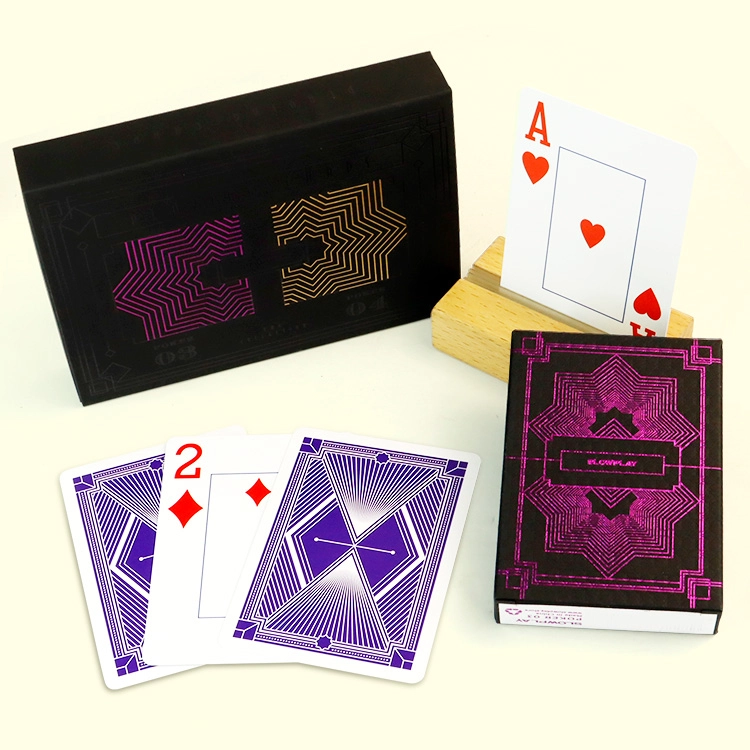
Double the Impact: The Substantial Two-Deck Custom Playing Card Gift That Demands Attention
About product selection
What materials do you use for your cards?
We use high-quality, durable materials to ensure the best finish and longevity for your cards. Options include standard cardstock, premium finishes, and eco-friendly materials.
What types of playing cards do you offer?
We offer a wide range of playing cards including standard decks, custom-designed decks, and specialty cards. Whether you need classic poker cards, bridge cards, or custom promotional decks, we have the options to fit your needs.
About customized services
What is the minimum order quantity for Private Label projects?
Our minimum order quantity usually starts at 500 pairs. However, we can handle smaller orders depending on the specific project requirements.
About logistics
Can you handle shipping and fulfillment?
Yes! We offer comprehensive fulfillment services, including storage, packing, and shipping. You can rely on us to ensure your cards reach their destination safely and on time.
After-sales support
Do you offer eco-friendly options?
Yes, we do offer eco-friendly materials and printing options. Please inquire about our sustainable options.

WE’D LOVE TO  HEAR
HEAR
FROM YOU
Please send us your inquiry details; our team will contact you ASAP.
20+ years of experience in custom playing cards, game cards, tarot cards, flashcards, and board games, as well as paper and paperboard box manufacturing.
bbilaser
sq_AL